

RECOGNITION — You Built Something That Required You
You know the hire was the right call. You needed someone to manage the account, run the ops, lead the team, handle the work that had been sitting in your inbox for six months while you were doing everything else. You interviewed carefully. You made the offer. They accepted. And within ninety days, instead of feeling lighter, you felt something you didn’t expect: more needed, not less.
Your inbox has more in it than before the hire. Not because the hire is failing, they’re not. It’s because every new decision they face arrives at your desk first, seeking context, seeking precedent, seeking the answer that lives in your head and nowhere else. The work they’re doing is real. What they can’t do yet, what the structure you’ve built doesn’t allow them to do, is decide. Without you.
This is not a hiring problem. It is not a talent problem. It is not a communication problem that more Slack channels will fix. It is a structural condition that almost every founder who has grown past ten employees encounters, and almost none were warned about. You built a business that required you to build it. Now it requires you to run it. And every person you add to the structure makes that condition more entrenched, not less, unless the architecture underneath changes.
You built a business that required you. That was exactly the right design, for then. The question worth asking now is whether it is still the right design for this.
THE GAP — The Architecture That Built This Has Reached Its Edge
The structure that produced your first five years of growth was not an accident. It was a precise expression of what the business needed: a founder who could hold every function, make every call, and move faster than any formal system could. That structure had a name, even if you never used it: founder-dependent architecture. And for a long time, it was the correct architecture.
Founder-dependent architecture produces results because founders are, by definition, the highest-context person in the room. You know the client, the vendor, the process, the standard, the exception, and the history. You can make a better decision faster than anyone else in the building, because you carry all the relevant information in your head. That is not a flaw. That is how businesses get built.
But there is a specific threshold every founder-led business approaches, usually somewhere between fifteen and forty employees, often around the $2M–$5M revenue mark, where the same architecture that built the business becomes the constraint that limits it. This is not a personal failure. It is a natural developmental threshold. The system that produced success at one stage has reached the edge of what it can produce at the next.
Three Structural Signatures of the Threshold
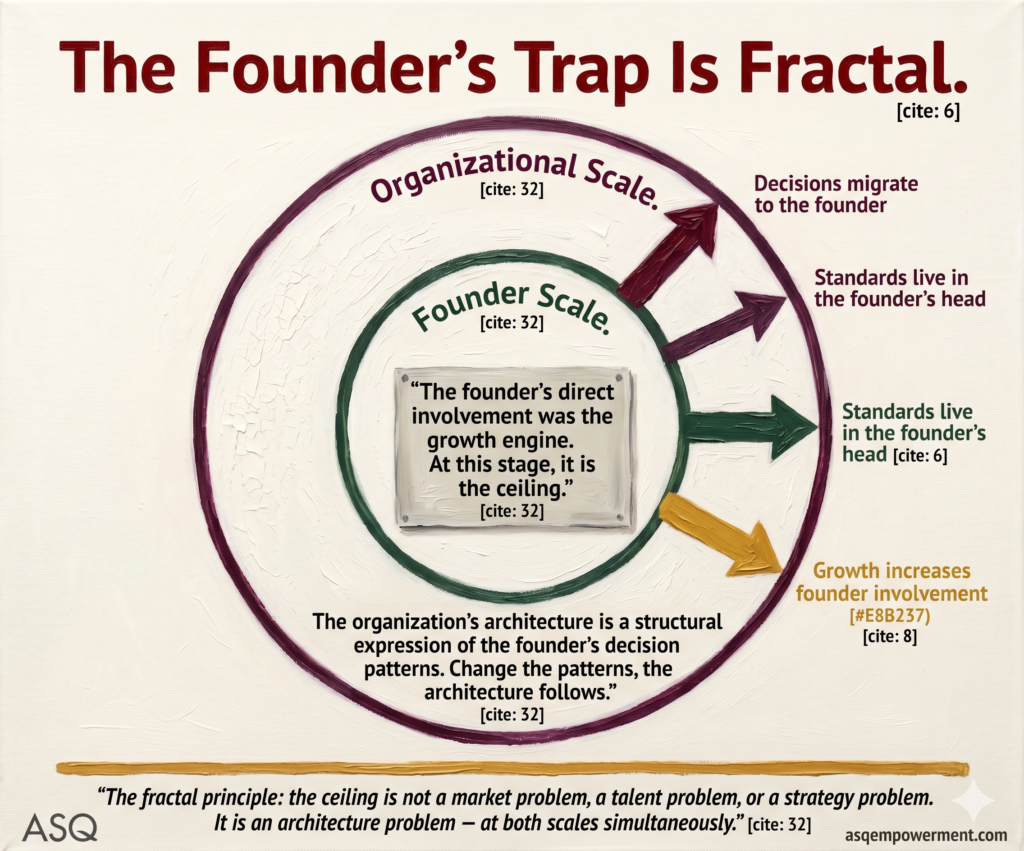
1. Decisions migrate upward. You hired managers. They are managing. But the decisions that require judgment, anything non-routine, anything ambiguous, anything with consequence, reliably find their way back to you. Not because your managers are incompetent. Because the decision-making authority and context were never formally transferred. The structure routes decisions through you because that is what it was built to do.
2. Your standards live in your head. The quality of your product, the tone of your client relationships, the way difficult conversations should be handled, you know all of this precisely. Your team knows you know it. What they don’t know, with the same precision, is how to make those calls when you are not in the room. Because the standards were never externalized into a system that could operate without you carrying them.3. Growth increases your involvement instead of decreasing it. Every additional employee should, in theory, reduce the volume of decisions that require your direct attention. In practice, in a founder-dependent architecture, each hire increases the coordination load, the context-setting requirement, and the escalation volume. You are not failing to delegate. The structure is not designed to receive delegation.
3. Growth increases your involvement instead of decreasing it. Every additional employee should, in theory, reduce the volume of decisions that require your direct attention. In practice, in a founder-dependent architecture, each hire increases the coordination load, the context-setting requirement, and the escalation volume. You are not failing to delegate. The structure is not designed to receive delegation.
THE FRACTAL DIAGNOSIS — The Business Is Running Your Pattern
There is a principle at the center of ASQ’s work that bears directly on what you’re experiencing. Your organization is not separate from you. It is a structural expression of your patterns, the decisions you make reflexively, the standards you hold in your head, the authority you extend and the authority you retain, the problems you trust others to solve and the ones you quietly pull back to yourself. The organization, at scale, reflects the internal architecture of the founder.
This is not a criticism. It is a systems observation. In the early years, this fractal relationship was the business’s greatest asset, your clarity, your standards, your judgment, your pace. The organization ran well because it ran like you. The problem is that the organization has grown beyond the capacity of any one person to carry it, while the architecture still requires you to carry it. The mismatch between the organization’s scale and its structural dependence on a single decision-maker is what produces the experience you’re having.
When founders describe being trapped in their own business, unable to take a real vacation, unable to step away for a week without the organization slowing down, unable to promote someone into a leadership role that would actually reduce the founder’s involvement, they are describing the fractal condition precisely. The organization cannot operate without its founder because it was built, at the structural level, to need its founder. Every system, every process, every accountability structure reflects that original design.
The path out of the trap is not a new hire. It is not a new management framework, a new project management tool, or a new set of weekly meetings. Those interventions address the symptoms without touching the structural source. The path out requires a change in the underlying architecture, how decisions get made, where authority lives, what the organization’s operating system looks like when the founder is not in the room.
What the Quarry Pattern Looks Like in a Founder-Led Business
In ASQ’s framework, the Quarry pattern names a specific organizational dynamic: the extraction of capacity from a single source until that source is depleted or the system fails. In founder-led businesses, the Quarry is the founder, the single point of intelligence, authority, and context that the entire organization draws from, continuously, without building its own reserves.
- Revenue growth stalls at the ceiling of the founder’s bandwidth.
- Hiring solves the work volume problem temporarily, then recreates the bottleneck.
- The founder cannot take extended time away without the organization visibly slowing.
- Staff are capable and loyal, but the structure does not give them the authority to be fully capable.
- Strategic planning happens, but the execution logic routes through the founder’s direct involvement.
The Quarry pattern is not a character flaw. It is a structural condition that capable, committed founders create by doing exactly what was required to build the business, and then not updating the architecture when the business grew beyond what that design could hold.
THE HORIZON: What Becomes Possible When the Architecture Changes
The horizon worth moving toward is specific and operational. It is not a different version of you. It is a different version of the structure that surrounds you, one where the decisions that don’t require your direct judgment are made cleanly, at the level closest to the work, without escalation. Where your standards are documented, transferable, and held by the system rather than carried in your head. Where the organization has a decision filter that operates whether or not you are in the room.
Founders who have moved through this architectural threshold describe a particular shift: they stop being the connective tissue and start being the strategic force. The day-to-day coordination that consumed thirty to forty percent of their week is handled by a structure that can hold it. The decisions that required their direct involvement are, increasingly, made by managers who have the authority, context, and framework to make them well. The founder’s time migrates toward the work that actually requires a founder, vision, relationships, key decisions, and the next stage of organizational development.
This is not a destination that arrives quickly or without deliberate architectural work. It is a developmental arc, not an event. But the arc has a specific direction: from a business that runs on you, to a business that runs on what you built. That shift does not require you to become a different kind of leader. It requires the structure to become capable of holding what you have already built.
The goal is not a business that doesn’t need you. It is a business that doesn’t need you for everything, one that reserves your presence for the work only you can do.
THE DIAGNOSTIC REFRAME: Two Questions Worth Sitting With This Week
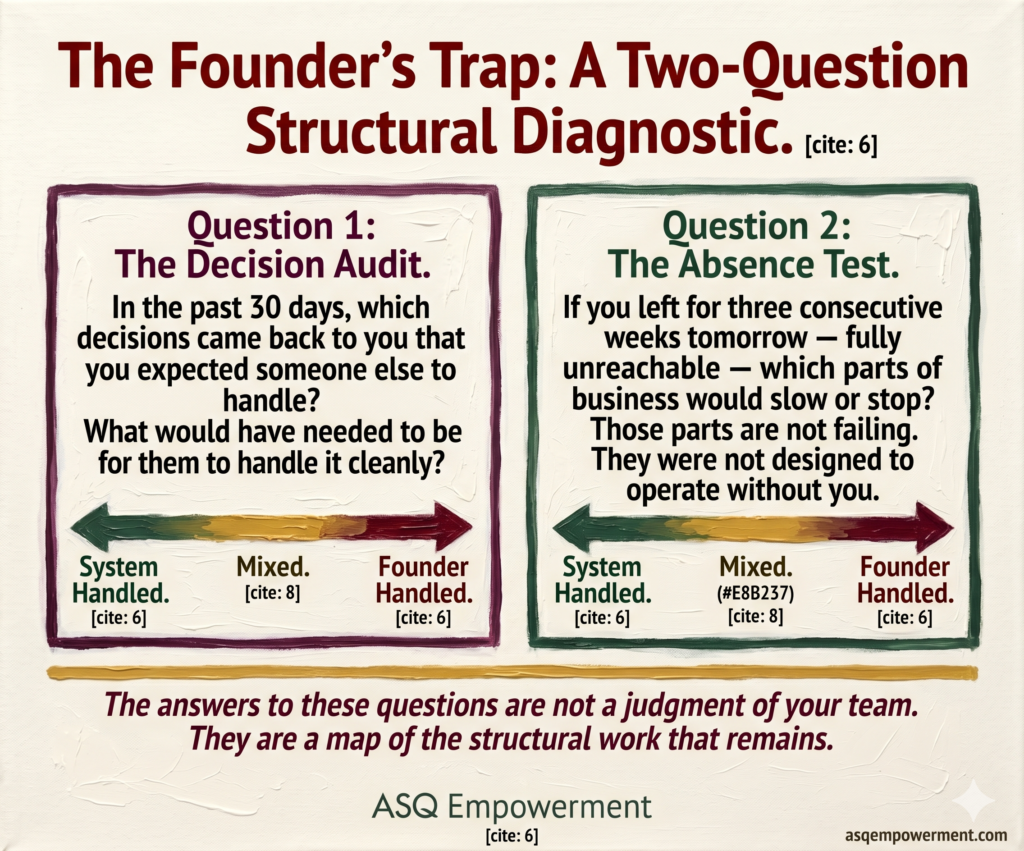
Before any architectural change is possible, it helps to locate precisely where the structure is currently holding the founder’s involvement in place. Two questions do this work more efficiently than any operational audit:
The first: In the past thirty days, which decisions came back to you that you expected someone else to handle, and what would have needed to be true for them to handle it cleanly? Be specific. Name the decisions, name the people involved, and name what was missing from the structure that would have allowed the decision to be made without you. The answer to that question is a precise map of where the architectural gap lives.
The second: If you left for three consecutive weeks tomorrow, fully unreachable, which parts of the business would slow down or stop, and which would continue? The parts that would slow are not evidence of a people problem. They are evidence of a structural condition: those parts of the business have not yet been given the architecture they need to function without your presence. They are not failing to operate independently. They were not designed to.
These questions are not designed to produce a to-do list. They are designed to shift the frame: from ‘what is wrong with my team’ to ‘what has the structure not yet been designed to hold.’ That shift in frame is where the architectural work begins.
THE CLOSE
The Founder’s Trap is not a trap because you made a mistake. It is a trap because the architecture that was exactly right for building the business has not yet been updated to hold what the business has become. The decision patterns, the authority structures, the standards that live in your head rather than in the system, these are not failures. They are artifacts of a design that worked well and now needs to evolve.
The 16Q Leadership Capacity Assessment at yoursoulcycle.com includes the Strategic Vision System, the diagnostic that maps how decision authority, organizational architecture, and the founder’s internal operating system are currently aligned with where the business needs to go. It takes twelve minutes. What it returns is not a score. It is a map of where your organization’s structural development is strong and where the Founder’s Trap is holding it in place.
If your business runs well when you’re in it, and noticeably differently when you’re not, the architecture is telling you something worth hearing. The assessment at yoursoulcycle.com is a useful place to start that conversation with precision.
REFERENCES
Collins, J. (2001). Good to great: Why some companies make the leap and others don’t. HarperBusiness.
Gerber, M. E. (1995). The E-myth revisited: Why most small businesses don’t work and what to do about it. HarperCollins.
Meadows, D. H. (2008). Thinking in systems: A primer. Chelsea Green Publishing.
Senge, P. M. (1990). The fifth discipline: The art and practice of the learning organization. Doubleday/Currency.
Harnish, V. (2014). Scaling up: How a few companies make it and why the rest don’t. Gazelles Inc. [VERIFY before publishing — confirm exact edition details]