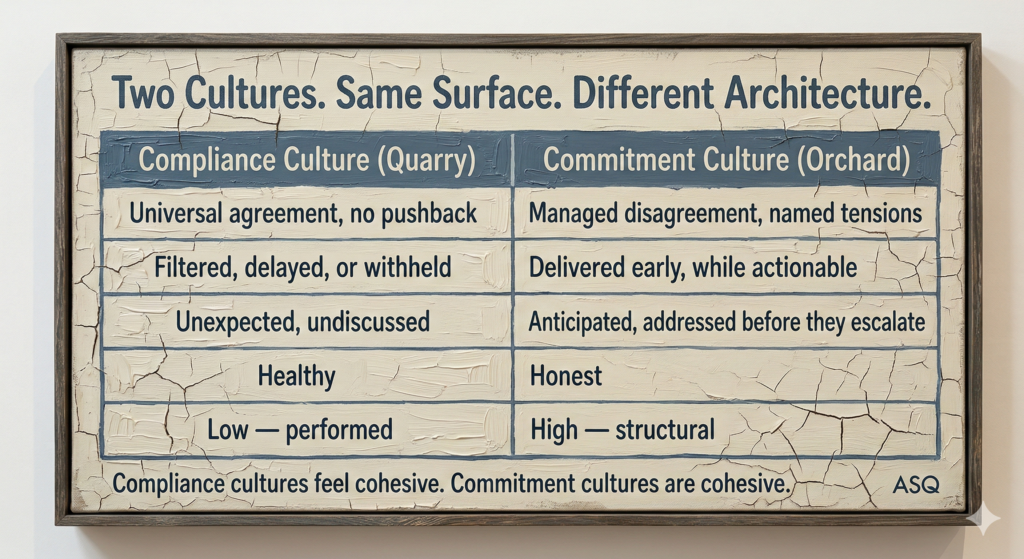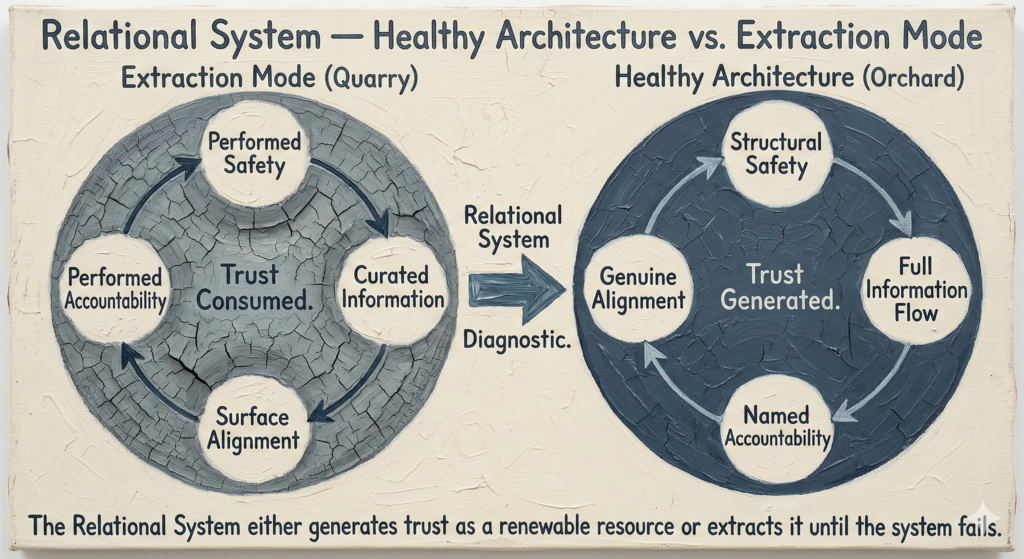
The leader who has built a regenerative organization is not the one who works less; it is the one whose absence the organization no longer fears.
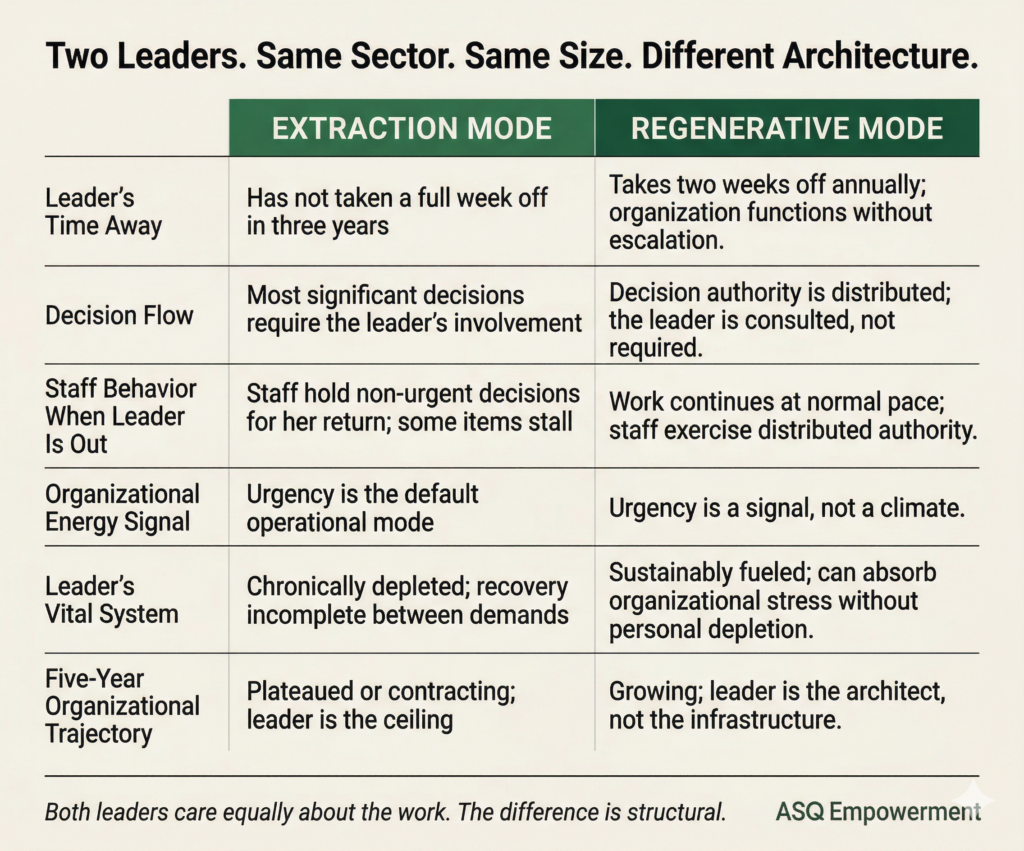
She has not taken a full week off in three years.
This is not a complaint; she has never framed it that way. It is simply the operational reality of running a mid-size organization alone at the center of every significant decision: grant renewal negotiations, program director conflicts, board chair communications, and the facilities emergency that came up in November. Each time she has considered taking time, something has arisen that only she can handle.
She is proud of what she has built. She is also, by any honest measure, the single point of failure in it.
Two miles away, a leader running an organization of comparable size and budget has just returned from two weeks at her family’s place in the Florida Keys. Her deputy director handled the one significant decision that arose while she was gone. No phone calls. No emails marked urgent. She came back to a team that had, in her words, “just kept working.”
These two leaders are not separated by talent, commitment, or resources. They are separated by a structural distinction that most leadership development frameworks never name directly: one organization has a functioning Vital System, and one is operating on the permanent extraction of its most essential resource.
What the Vital System Actually Is
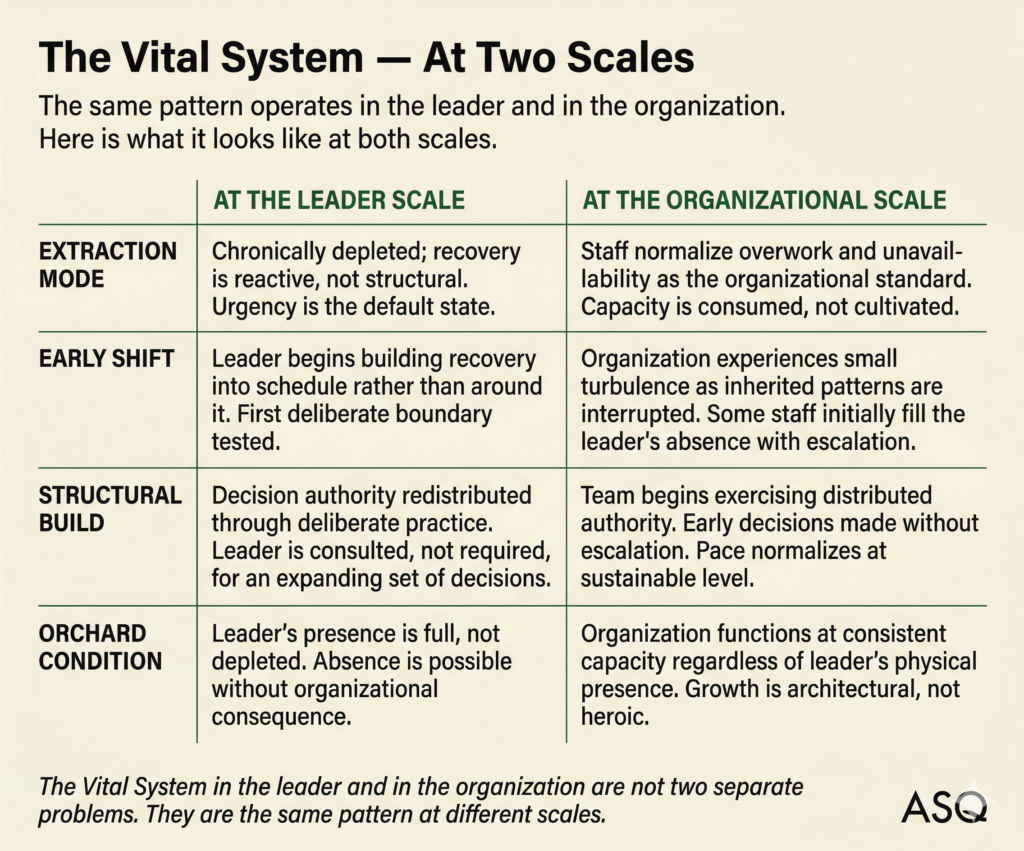
The Vital System is the first of ASQ’s Four Integrated Systems, and it is the one that makes all others possible. It governs the capacity for sustained, effective functioning: at the individual level, the leader’s physical and nervous system resources, her ability to recover between demands, and the quality of her presence under pressure. At the organizational level, it is the aggregate health of the people doing the work, the culture of pace, recovery, and sustainable output that either exists or is being consumed.
The precise fractal here: a leader whose Vital System is running in extraction mode, chronically depleted, urgency-addicted, functionally unable to be absent, will build an organization that replicates those conditions. Not because she intends to. Because the organization learns from what she models, and because heroic availability becomes the informal standard against which every staff member measures their own contribution.
This is not a metaphor. It is an organizational dynamics pattern documented consistently in the research literature on leader behavior and institutional culture. Leaders model the pace. The pace becomes the norm. The norm becomes the system (Loehr & Schwartz, 2003; Senge, 1990).
The Orchard leader, the one who came back from the Keys to a team that had kept working, did not produce this outcome by relaxing her standards. She produced it by building structures that distribute the organizational load before she needed to be absent.
What the Orchard Leader Built — and When
The distinction between the two leaders above is not a personality difference. It is not a matter of the first leader working too hard or the second leader working too little. It is a structural difference that was created years before the vacation happened.
The Orchard leader built three things that the extraction leader has not yet built:
Distributed decision authority. The Orchard leader has made explicit, in writing, through practice, through repeated correction of her own instinct to be consulted, the decisions her team is empowered to make without her. This is not a delegation checklist. It is the result of repeated, deliberate work to identify where her presence was structurally required versus where it had simply become habitual. The distinction matters: habitual centralization and structural necessity are not the same thing, and confusing them is how capable leaders become irreplaceable for the wrong reasons.
Vital System recovery built into the rhythm, not the exception. The extraction leader recovers when she can. The Orchard leader recovers on schedule. This difference, between recovery as an emergency measure and recovery as a structural feature of how she leads, shapes everything downstream. The quality of the decision made at the end of a long week by a depleted leader and the quality of the decision made by a leader who is genuinely rested are not equivalent. Pretending otherwise is a competence problem dressed as a commitment signal.
A team built to function, not to need. The extraction leader’s team has, over time, learned that the leader is the answer to ambiguity, to authority gaps, to decisions that feel risky to make alone. This is not the team’s failure; it is a structural outcome of how the organization was built. The Orchard leader has done the harder work of building a team that has been given real authority, experienced using it, and developed the judgment that comes from genuine responsibility. This does not happen through a single delegation exercise. It happens through years of consistent structural design.
Why “Working Less” Is the Wrong Frame
The most consistent misreading of regenerative leadership is that it describes a leader who works less. This is not accurate, and it is worth naming directly because the misreading produces the wrong response: leaders who are operating in extraction mode often respond to the concept of regenerative leadership by concluding it is not for them, that their organization, their sector, or their current phase of growth requires the extraction model for now.
The Orchard leader does not work less. She works differently, with a qualitatively different kind of presence, a different distribution of authority, and a deliberate structural relationship to her own capacity. The work required to build an Orchard organization is, in the early phases, significant. Identifying where decision authority can be distributed is not simple. Building a team’s capacity to exercise genuine authority takes time and requires tolerating mistakes that the extraction leader would never allow to happen, because she is always available to prevent them.
The distinction is not effort versus ease. It is extraction versus regeneration. In the extraction model, the organization’s capacity is borrowed from the leader’s reserves, and the debt accumulates. In the regenerative model, the organization’s capacity is cultivated structurally so that it does not depend on any single person’s heroic availability.
The test ASQ uses for Vital System health is not “how much time off does the leader take?” It is: “What happens when the leader is unavailable for two weeks?” That answer tells you more about an organization’s structural health than any strategic plan, mission statement, or board presentation.
If the answer is “we manage, but things slow down, and some decisions wait,” that is an early Orchard condition. Something is working.
If the answer is “honestly, it would be difficult to fully step away,” that is diagnostic information. Not a personal failing. A structural gap.
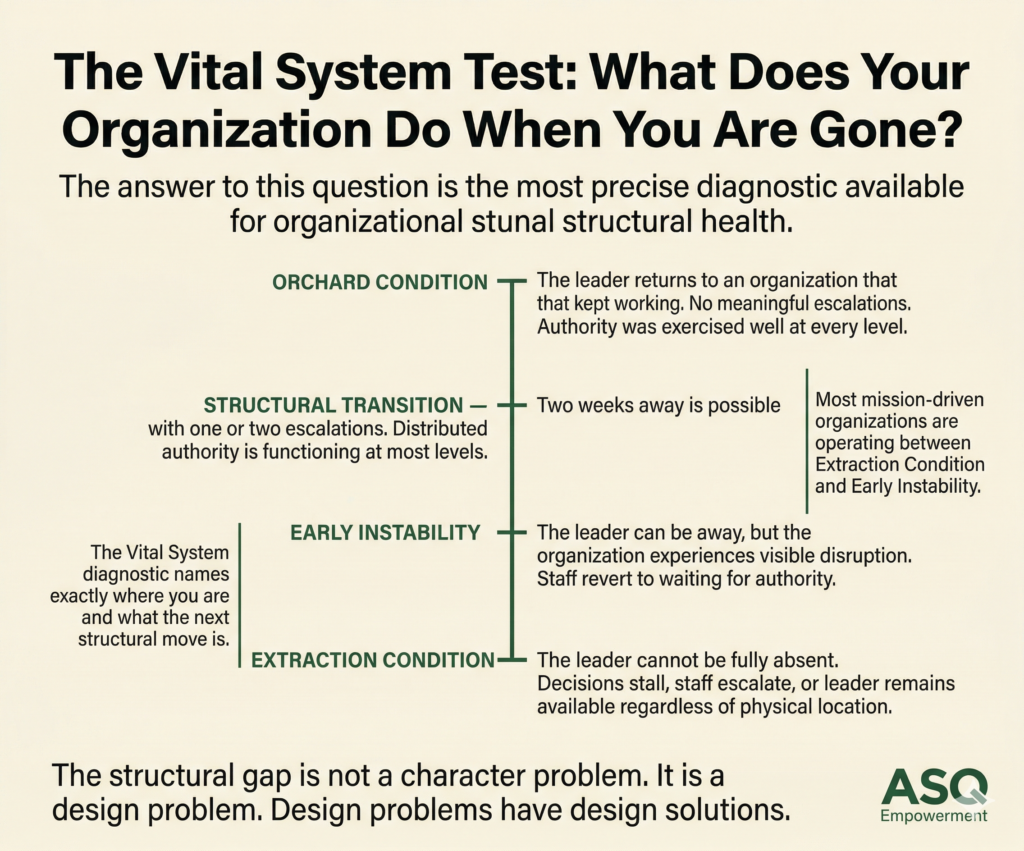
The leader who cannot be absent is not the leader who cares most. She is the leader whose organization has not yet been built to function without her. That is a structural condition, and structural conditions are addressable through structural means.
The discovery conversation with ASQ begins with one question: What would have to be true about your organization for you to take two weeks off without consequence? If you are ready to work through that question with someone who has a specific methodology for answering it, schedule a conversation with Dr. Jessie Ferreira at https://yoursoulcycle.com/asq-scheduling-calendar/
#RegenerativeLeadership #CoherentLeadership #FromQuarryToOrchard #LeadershipFromTheInsideOut #SustainableLeadership Instagram: #RegenerativeLeadership #CoherentLeadership #FromQuarryToOrchard #LeadershipFromTheInsideOut #OrganizationalCoherence
References
Loehr, J., & Schwartz, T. (2003). The power of full engagement: Managing energy, not time, is the key to high performance and personal renewal. Free Press.
Senge, P. M. (1990). The fifth discipline: The art and practice of the learning organization. Doubleday/Currency.
Meadows, D. H. (2008). Thinking in systems: A primer. Chelsea Green Publishing.
Collins, J. (2001). Good to great: Why some companies make the leap and others don’t. HarperBusiness.
Maslach, C., & Leiter, M. P. (2016). Understanding the burnout experience: Recent research and its implications for psychiatry. World Psychiatry, 15(2), 103–111. https://doi.org/10.1002/wps.20311