

You built a business that required you. That was exactly the right design, for then. The question worth asking now is whether it is still the right design for this.

The Initiative Graveyard: Why Mission-Driven Organizations Keep Starting Things They Cannot Finish
When the problem isn’t the plan — it’s the system underneath the plan
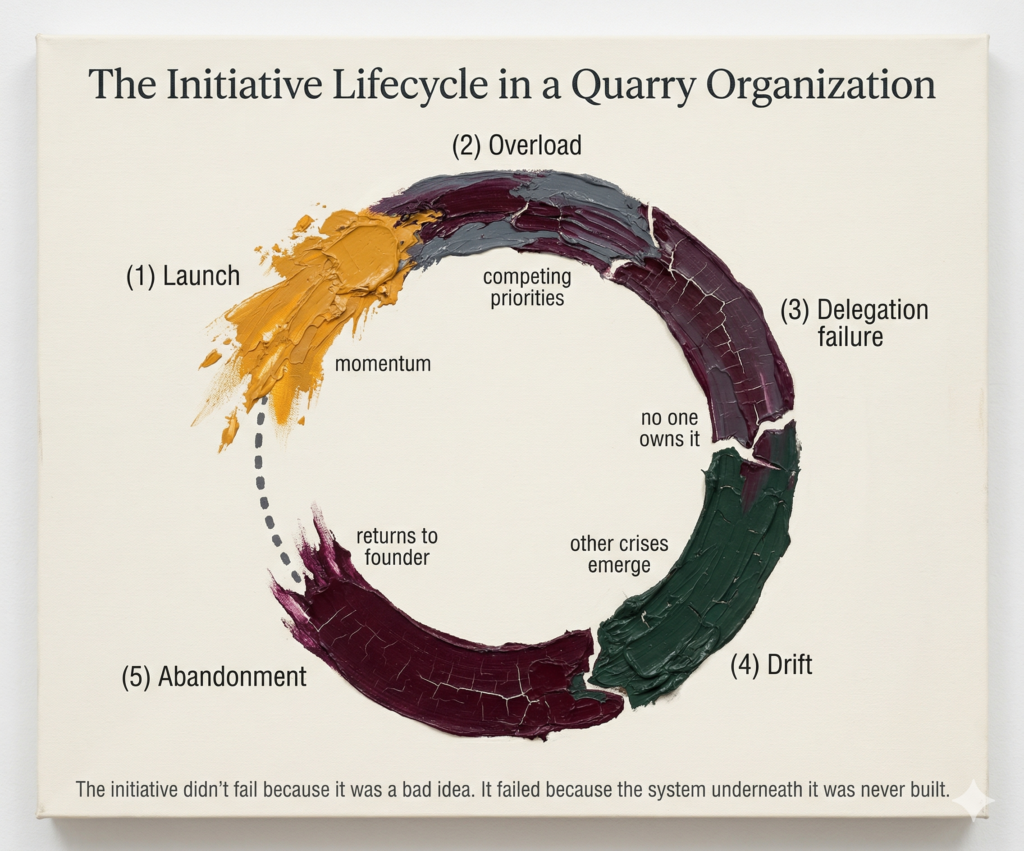
The Monday morning that repeats itself
The executive director has seen this before. A new initiative launches with genuine energy — a program expansion, a staff development series, a data infrastructure project, a community partnership that could change the organization’s reach. The planning session is productive. The whiteboard fills up. People leave energized.
Six weeks later, the initiative is living in a folder no one opens.
This is not a story about poor planning. It is not a story about uncommitted staff or unrealistic timelines. It is a story about a structural condition that affects nearly every mission-driven organization operating under resource pressure — and it has a name.
The Creative System under extraction
ASQ’s Fractal Coherence Methodology maps four integrated systems that operate at both individual and organizational scale simultaneously. The Creative System is the domain of agency, generativity, and forward design — the capacity of a person or an organization to imagine something that does not yet exist and bring it into being with coherent effort over time.
In a healthy Creative System, ideas are resourced, ownership is distributed, and the organization has enough structural slack to absorb the demands of building something new alongside running what already exists. New initiatives move through a development arc: conception, design, delegation, iteration, stabilization.
In a Quarry organization — one running on extraction, heroism, and founder-dependency — the Creative System operates under a specific and predictable distortion. The capacity to conceive is intact. The capacity to complete is not. Leadership generates ideas faster than the system can absorb them. Initiatives launch without clear ownership. Ownership without authority produces the same result as no ownership at all. Structural slack does not exist because every available unit of human capacity is already committed to keeping what is running from stopping.
The whiteboard fills. The folder stays closed.
What this looks like from inside
There is a recognizable texture to Creative System failure in a mission-driven organization. It rarely announces itself as a systems problem. It announces itself as a people problem.
The executive director concludes the team lacks follow-through. The team concludes leadership lacks focus. Both observations contain partial truth. Neither observation names the structural condition underneath them.
Gallup’s research on employee engagement is instructive here: organizations where employees report that their opinions do not count, their roles lack clear ownership, and new ideas disappear after announcement show predictable disengagement signatures within 18 months — not because staff do not care, but because the system has taught them that creative investment carries no return (Gallup, 2023). Staff in a Quarry Creative System do not stop caring. They stop launching. Self-protection, not apathy, explains the silence in the room when the next initiative is announced.
The executive director, sitting at the head of the table, may read that silence as resistance. It is, in fact, data.
The fractal pattern
This is where the Quarry frame becomes most precise. The Creative System failure does not begin with the organization. It begins — and replicates — at the leadership scale.
Most executive directors leading mission-driven organizations carry what might be called a creation without completion pattern in their own cognitive and operational style. The drive to generate — new programs, new partnerships, new approaches — is one of the qualities that made them effective in earlier roles. In the executive director position, that generative capacity is operating inside a system that cannot receive it at full volume.
The pattern: the leader generates faster than the organization can absorb. The organization, unable to complete what has been started, produces visible dysfunction. The leader, reading that dysfunction as evidence that more initiative is needed, generates more. The cycle accelerates. The graveyard grows.
This is not a character flaw. It is a fractal expression of a Creative System that has never been designed — only inherited.
The structural cause
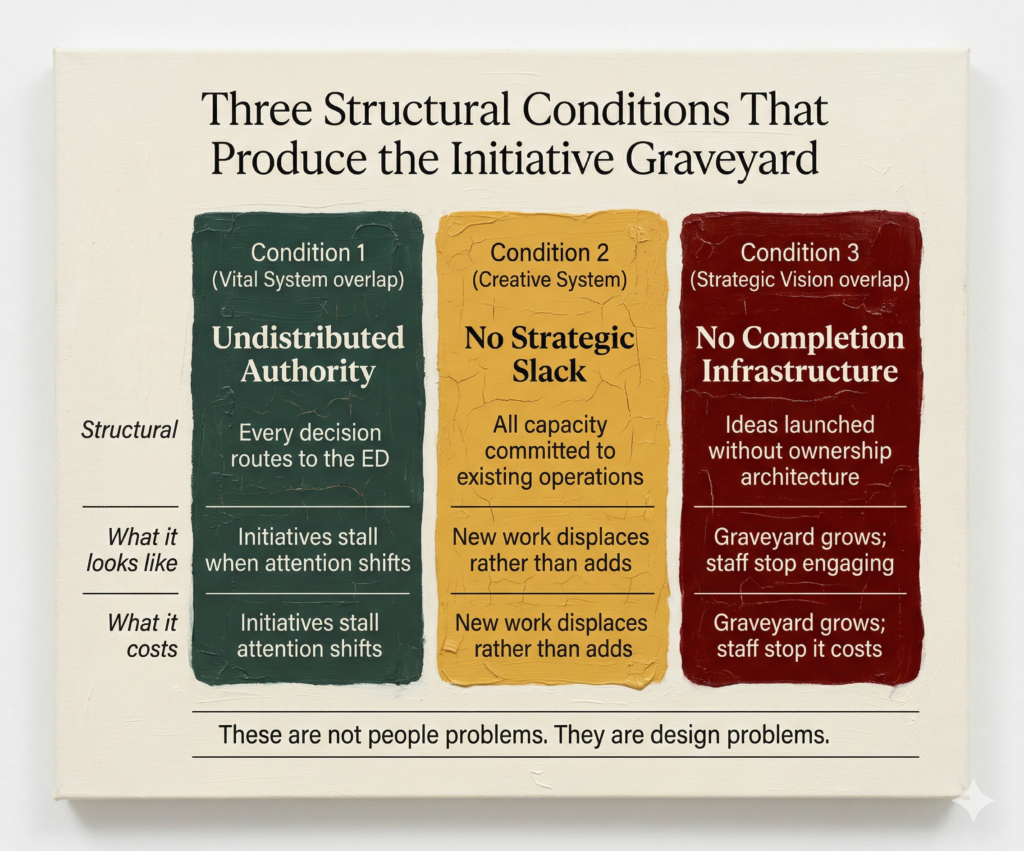
Three architectural conditions produce Initiative Graveyard syndrome in mission-driven organizations. They are predictable, diagnosable, and structural:
1. Distributed authority has never been built. The executive director holds decision rights that should belong to program directors, operations leads, and team managers. New initiatives require the ED’s involvement at every inflection point — which means they move only as fast as the ED can move, and they stall when the ED’s attention goes elsewhere.
2. Strategic slack does not exist. The organization is running at or above capacity on existing commitments. Every staff member’s calendar is full. New initiatives must be absorbed into a system with no available capacity, which means they displace existing work rather than adding to it — producing the perception of chaos rather than growth.
3. The Creative System has no infrastructure. There is no formalized process for moving an idea from conception to ownership to delivery accountability. Initiatives are announced but not designed. Design without infrastructure is aspiration, not execution.
These three conditions are not caused by individual failure. They are the predictable output of an organization that has grown through heroism rather than architecture.
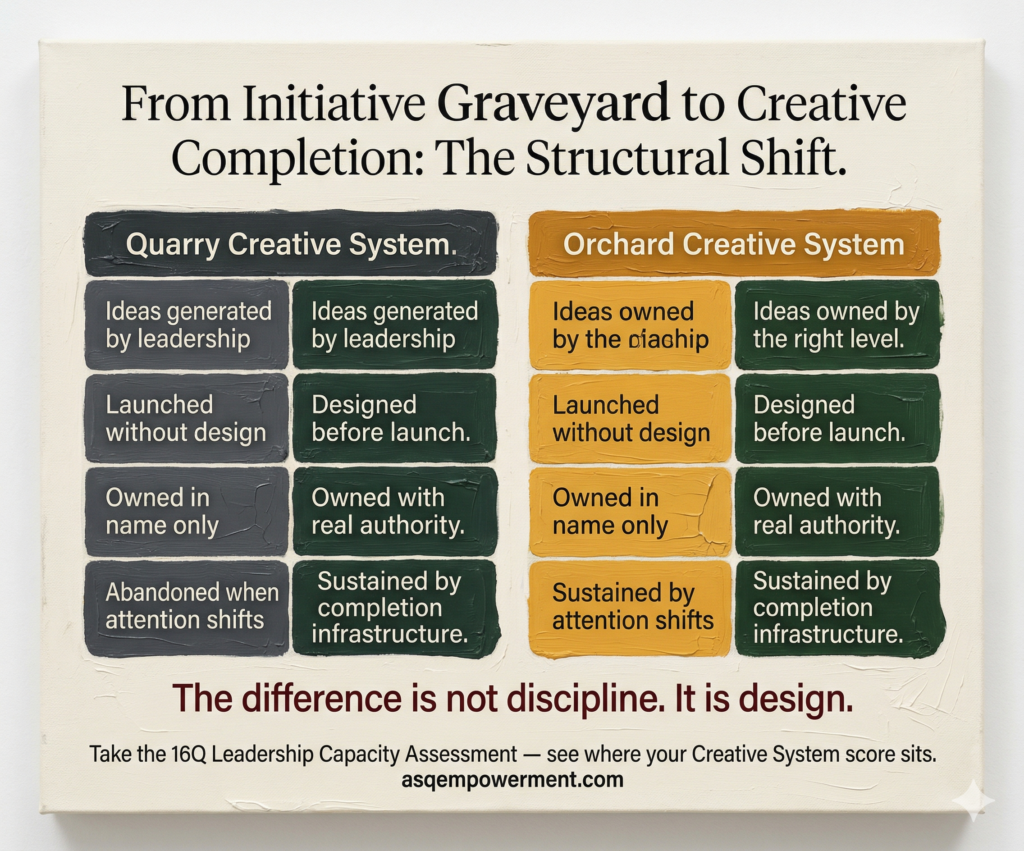
The difference between a Quarry and an Orchard Creative System
An Orchard organization does not generate fewer ideas. It generates ideas inside a system designed to receive them.
The distinction is architectural, not motivational. An executive director with a well-functioning Creative System does not have more discipline or more restraint. They have built — deliberately or through good guidance — the structural conditions that allow initiative to move from conception to completion without routing everything through a single human bottleneck.
Distributed authority means program directors can own their initiatives with genuine decision rights. Strategic slack means the organization has built some capacity reserve — not abundance, but room to absorb what is new without displacing what is running. Completion infrastructure means every initiative enters a formalized development process: named owner, defined scope, milestone accountability, and a review cadence that catches drift before it becomes abandonment.
The whiteboard in the Orchard still fills. But the folder gets opened.
What the data shows about sustainable organizational creativity
Research on organizational innovation in resource-constrained nonprofit environments consistently identifies the same bottleneck: the constraint is not ideation, it is structural capacity for execution. A longitudinal study of mission-driven organizations found that those with documented decision-rights frameworks and formalized initiative management processes were 2.6 times more likely to successfully implement strategic priorities than those without such frameworks, regardless of budget size (Battilana & Lee, 2014). The constraint, in other words, is never the mission. It is the architecture.
This finding maps precisely onto what ASQ observes in the Creative System across the organizations it serves. The ideas are not the problem. The leaders generating them are not the problem. The structure available to receive and process them is where the dysfunction lives — and where the intervention belongs.
The path forward
The initiative graveyard is not evidence that your organization cannot execute. It is evidence that execution architecture has not yet been built.
The diagnostic work begins with one question: Does your organization have a formalized process for moving from idea to ownership to completion accountability — or does each new initiative invent its own process from scratch? If the answer is the latter, you are not looking at a people problem or a commitment problem. You are looking at the predictable output of a Creative System that has never been designed.
That design is not complex. It is architectural.
If the pattern described in this article is familiar — if your organization has a whiteboard full of good ideas and a folder full of unfinished ones — the Leadership Capacity Assessment is a useful starting point. It takes five minutes and maps where your organization’s Creative System score sits relative to the other three systems. The results are specific. Book a conversation with Jessie Ferreira at yoursoulcycle.com if you want to understand what those results mean for your organization.
#NonprofitLeadership #ExecutiveDirector #OrganizationalHealth #MissionDriven #LeadershipDevelopment Instagram: #NonprofitLife #ExecutiveLeadership #OrchardLeadership #LeadershipCoherence #ASQEmpowerment
References
Battilana, J., & Lee, M. (2014). Advancing research on hybrid organizing — insights from the study of social enterprises. Academy of Management Annals, 8(1), 397–441. https://doi.org/10.5465/19416520.2014.893615
Gallup, Inc. (2023). State of the global workplace: 2023 report. Gallup Press. https://www.gallup.com/workplace/349484/state-of-the-global-workplace.aspx
Gelles, D. (2022). The man who broke capitalism: How Jack Welch gutted the heartland and crushed the soul of corporate America — and how to undo his legacy. Simon & Schuster.
Meadows, D. H. (2008). Thinking in systems: A primer. Chelsea Green Publishing.Senge, P. M. (1990). The fifth discipline: The art and practice of the learning organization. Doubleday/Currency.

The Orchard Leader: What Regenerative Leadership Actually Looks Like in Practice
The leader who has built a regenerative organization is not the one who works less; it is the one whose absence the organization no longer fears.
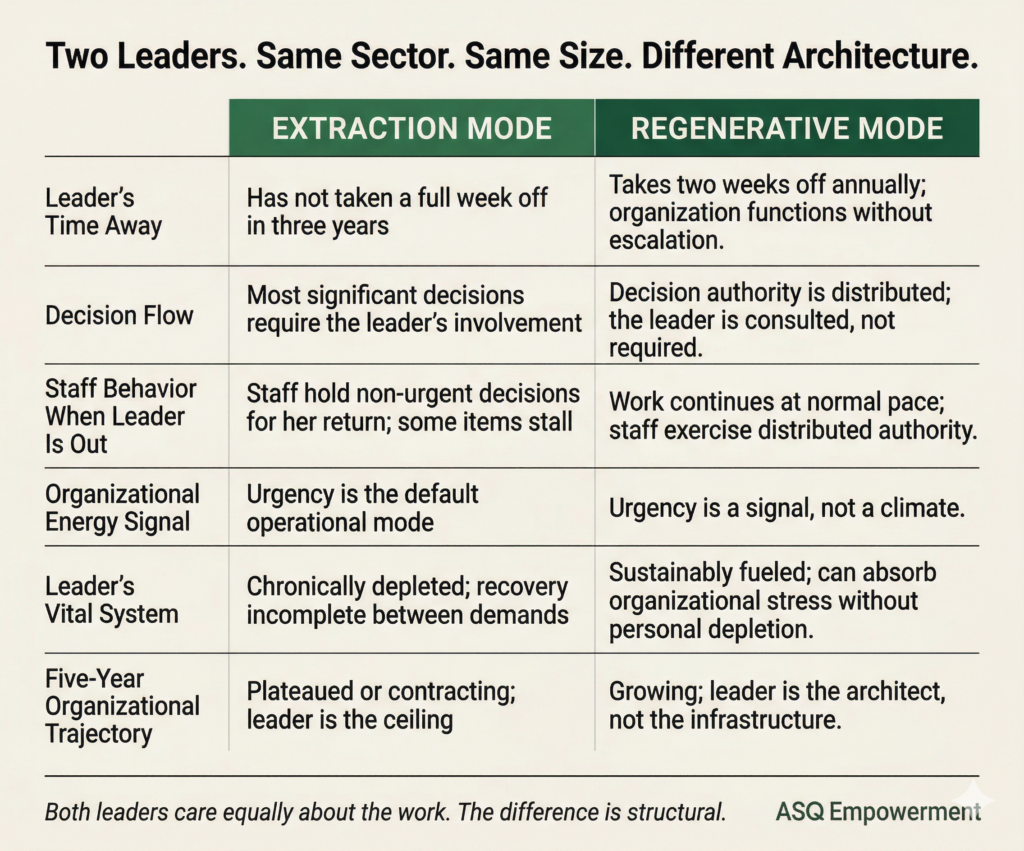
She has not taken a full week off in three years.
This is not a complaint; she has never framed it that way. It is simply the operational reality of running a mid-size organization alone at the center of every significant decision: grant renewal negotiations, program director conflicts, board chair communications, and the facilities emergency that came up in November. Each time she has considered taking time, something has arisen that only she can handle.
She is proud of what she has built. She is also, by any honest measure, the single point of failure in it.
Two miles away, a leader running an organization of comparable size and budget has just returned from two weeks at her family’s place in the Florida Keys. Her deputy director handled the one significant decision that arose while she was gone. No phone calls. No emails marked urgent. She came back to a team that had, in her words, “just kept working.”
These two leaders are not separated by talent, commitment, or resources. They are separated by a structural distinction that most leadership development frameworks never name directly: one organization has a functioning Vital System, and one is operating on the permanent extraction of its most essential resource.
What the Vital System Actually Is
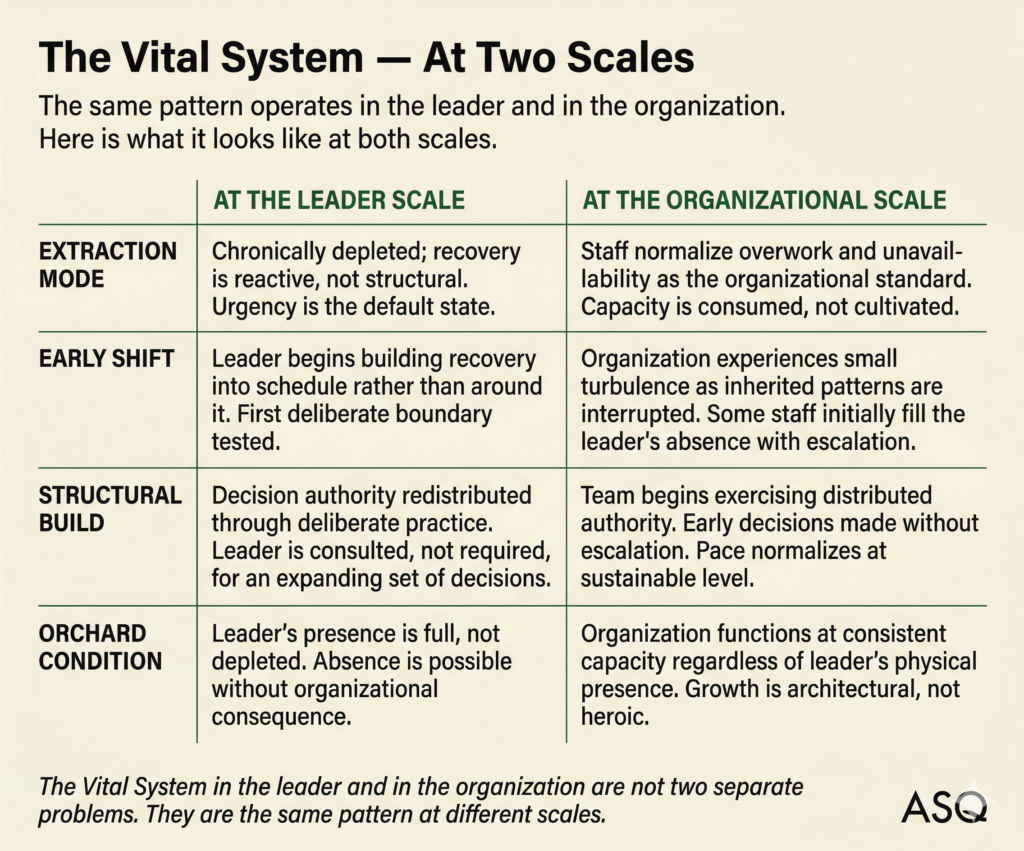
The Vital System is the first of ASQ’s Four Integrated Systems, and it is the one that makes all others possible. It governs the capacity for sustained, effective functioning: at the individual level, the leader’s physical and nervous system resources, her ability to recover between demands, and the quality of her presence under pressure. At the organizational level, it is the aggregate health of the people doing the work, the culture of pace, recovery, and sustainable output that either exists or is being consumed.
The precise fractal here: a leader whose Vital System is running in extraction mode, chronically depleted, urgency-addicted, functionally unable to be absent, will build an organization that replicates those conditions. Not because she intends to. Because the organization learns from what she models, and because heroic availability becomes the informal standard against which every staff member measures their own contribution.
This is not a metaphor. It is an organizational dynamics pattern documented consistently in the research literature on leader behavior and institutional culture. Leaders model the pace. The pace becomes the norm. The norm becomes the system (Loehr & Schwartz, 2003; Senge, 1990).
The Orchard leader, the one who came back from the Keys to a team that had kept working, did not produce this outcome by relaxing her standards. She produced it by building structures that distribute the organizational load before she needed to be absent.
What the Orchard Leader Built — and When
The distinction between the two leaders above is not a personality difference. It is not a matter of the first leader working too hard or the second leader working too little. It is a structural difference that was created years before the vacation happened.
The Orchard leader built three things that the extraction leader has not yet built:
Distributed decision authority. The Orchard leader has made explicit, in writing, through practice, through repeated correction of her own instinct to be consulted, the decisions her team is empowered to make without her. This is not a delegation checklist. It is the result of repeated, deliberate work to identify where her presence was structurally required versus where it had simply become habitual. The distinction matters: habitual centralization and structural necessity are not the same thing, and confusing them is how capable leaders become irreplaceable for the wrong reasons.
Vital System recovery built into the rhythm, not the exception. The extraction leader recovers when she can. The Orchard leader recovers on schedule. This difference, between recovery as an emergency measure and recovery as a structural feature of how she leads, shapes everything downstream. The quality of the decision made at the end of a long week by a depleted leader and the quality of the decision made by a leader who is genuinely rested are not equivalent. Pretending otherwise is a competence problem dressed as a commitment signal.
A team built to function, not to need. The extraction leader’s team has, over time, learned that the leader is the answer to ambiguity, to authority gaps, to decisions that feel risky to make alone. This is not the team’s failure; it is a structural outcome of how the organization was built. The Orchard leader has done the harder work of building a team that has been given real authority, experienced using it, and developed the judgment that comes from genuine responsibility. This does not happen through a single delegation exercise. It happens through years of consistent structural design.
Why “Working Less” Is the Wrong Frame
The most consistent misreading of regenerative leadership is that it describes a leader who works less. This is not accurate, and it is worth naming directly because the misreading produces the wrong response: leaders who are operating in extraction mode often respond to the concept of regenerative leadership by concluding it is not for them, that their organization, their sector, or their current phase of growth requires the extraction model for now.
The Orchard leader does not work less. She works differently, with a qualitatively different kind of presence, a different distribution of authority, and a deliberate structural relationship to her own capacity. The work required to build an Orchard organization is, in the early phases, significant. Identifying where decision authority can be distributed is not simple. Building a team’s capacity to exercise genuine authority takes time and requires tolerating mistakes that the extraction leader would never allow to happen, because she is always available to prevent them.
The distinction is not effort versus ease. It is extraction versus regeneration. In the extraction model, the organization’s capacity is borrowed from the leader’s reserves, and the debt accumulates. In the regenerative model, the organization’s capacity is cultivated structurally so that it does not depend on any single person’s heroic availability.
The test ASQ uses for Vital System health is not “how much time off does the leader take?” It is: “What happens when the leader is unavailable for two weeks?” That answer tells you more about an organization’s structural health than any strategic plan, mission statement, or board presentation.
If the answer is “we manage, but things slow down, and some decisions wait,” that is an early Orchard condition. Something is working.
If the answer is “honestly, it would be difficult to fully step away,” that is diagnostic information. Not a personal failing. A structural gap.
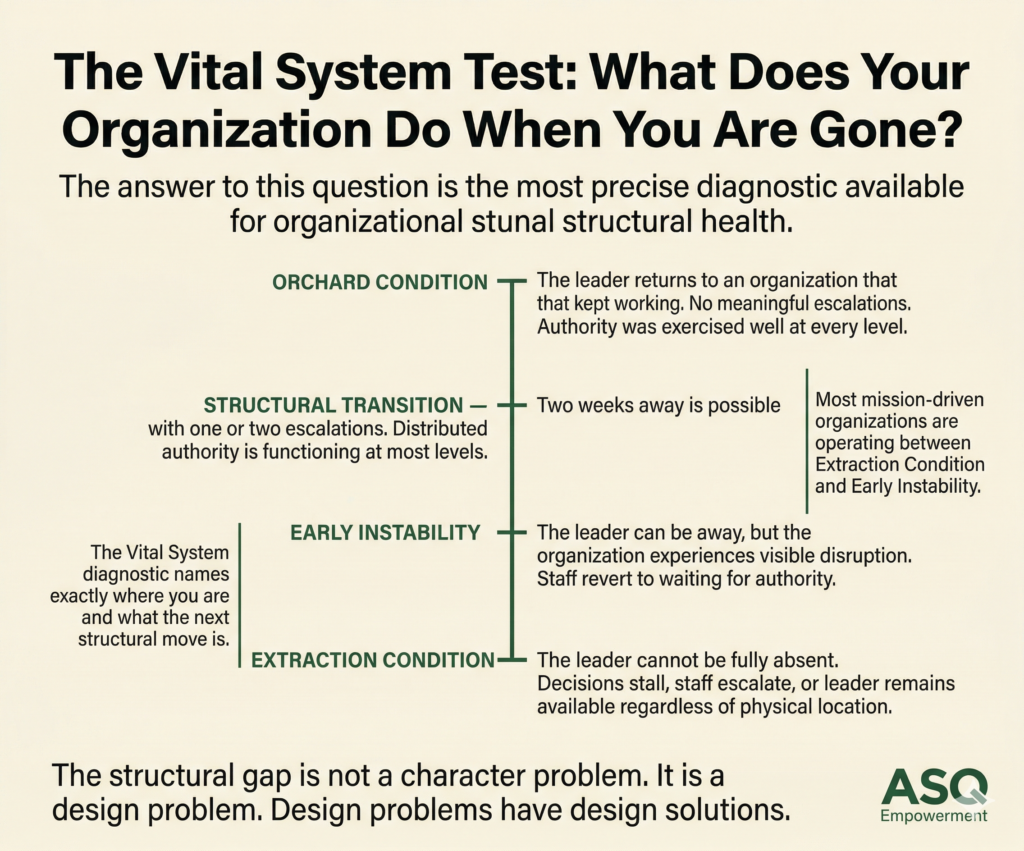
The leader who cannot be absent is not the leader who cares most. She is the leader whose organization has not yet been built to function without her. That is a structural condition, and structural conditions are addressable through structural means.
The discovery conversation with ASQ begins with one question: What would have to be true about your organization for you to take two weeks off without consequence? If you are ready to work through that question with someone who has a specific methodology for answering it, schedule a conversation with Dr. Jessie Ferreira at https://yoursoulcycle.com/asq-scheduling-calendar/
#RegenerativeLeadership #CoherentLeadership #FromQuarryToOrchard #LeadershipFromTheInsideOut #SustainableLeadership Instagram: #RegenerativeLeadership #CoherentLeadership #FromQuarryToOrchard #LeadershipFromTheInsideOut #OrganizationalCoherence
References
Loehr, J., & Schwartz, T. (2003). The power of full engagement: Managing energy, not time, is the key to high performance and personal renewal. Free Press.
Senge, P. M. (1990). The fifth discipline: The art and practice of the learning organization. Doubleday/Currency.
Meadows, D. H. (2008). Thinking in systems: A primer. Chelsea Green Publishing.
Collins, J. (2001). Good to great: Why some companies make the leap and others don’t. HarperBusiness.
Maslach, C., & Leiter, M. P. (2016). Understanding the burnout experience: Recent research and its implications for psychiatry. World Psychiatry, 15(2), 103–111. https://doi.org/10.1002/wps.20311

The Founder Bottleneck Is Not a Time Problem
Why mission-driven organizations stall the moment their founder steps back — and the architectural diagnosis most leaders never receive.
The Moment of Recognition
You’ve tried delegating. You’ve hired capable people, handed off responsibilities, and stepped back from the day-to-day — at least in theory. But within days, the emails start. The staff questions pile up. The donor call needs you on it. The program decision gets made wrong, or not at all, until you weigh in.
You are not failing at delegation. You are experiencing the consequence of an organizational design that was never meant to function without you.
This is the founder bottleneck. And despite how it feels from the inside — like an endless list of tasks you haven’t released — it is not a time problem. It is an architecture problem.
The organization is not waiting for you to let go. It is waiting for the structures that make letting go possible.
What the Research Actually Shows
The data on founder dependency in mission-driven organizations is not encouraging. A 2019 study published in the Nonprofit and Voluntary Sector Quarterly found that founder-led nonprofits are significantly more likely to experience operational disruption during leadership transitions than professionally managed organizations with documented systems (Santora et al., 2019). The primary driver was not leadership quality — it was the absence of transferable institutional knowledge.
Meanwhile, Gallup’s State of the American Workplace report consistently identifies one of the strongest predictors of team performance as clarity of role and decision authority (Gallup, 2023). When staff don’t know what decisions they own, they escalate everything. When everything escalates, it lands on the person at the top.
This is not dysfunction. It is a predictable output of a predictable design.
The founder built the organization by making every decision, holding every relationship, and solving every problem. That is how organizations get started. It is not how they sustain.
The Architecture of Dependency

Consider what happens in a typical founder-dependent organization when the founder takes a two-week vacation.
On day one, the out-of-office reply manages the volume. By day three, staff are sending urgent messages. By day five, there is a decision that genuinely cannot wait — a vendor contract, a program adjustment, a personnel issue. By day eight, the founder is checking email from vacation. By day twelve, they’ve returned early.
Every leader reading this knows this story. Many have lived it. The common interpretation is: ‘I need to let go more.’ The more accurate diagnosis: ‘My organization was not designed with the architecture that makes letting go safe.’
The Vital System framework maps four domains of organizational capacity: energy and sustainability, relational trust and culture, innovation and adaptive thinking, and strategic direction. The founder bottleneck is primarily a Vital System failure — not of the founder’s energy, but of the organization’s structural energy. The institution cannot sustain its own operations without drawing from a single human source.
This is what we mean by extractive architecture. Just as Jack Welch’s forced-ranking system at GE extracted maximum short-term performance from employees by treating them as disposable inputs rather than renewable assets (Gelles, 2022), the founder-dependent organization extracts maximum output from its leader by treating their capacity as infinite — until it isn’t.
The Welch Parallel: Quarry Logic in Nonprofit Form
Jack Welch became famous for a management philosophy built on measurable short-term results, internal competition, and the elimination of anything that didn’t perform against quarterly metrics. His approach spread far beyond GE. It became the dominant model for American management culture across sectors.
What went largely unexamined was the structural consequence: organizations that performed extraordinarily well as long as the system was intensely managed from the top, and that became fragile — sometimes catastrophically — the moment that management pressure was removed. Boeing’s post-merger culture, which prioritized financial engineering over engineering discipline, is perhaps the most documented example of what happens when Welch-style extraction replaces institutional resilience (Gelles, 2022).
Mission-driven organizations rarely think of themselves as Welch disciples. But the logic is identical: build the institution around the highest-performing individual, extract maximum output from that individual’s capacity, and treat the system’s dependence on that person as a feature rather than a flaw.
The flaw becomes visible only when the person steps away.
Milton Hershey built something structurally different. His company, founded in 1894, survived the Great Depression, two world wars, and multiple leadership transitions — not because each new leader was as gifted as Hershey, but because Hershey built institutional architecture that transferred (D’Antonio, 2006). The knowledge, the relationships, the decision logic — these lived in the organization, not only in the man.
That is what organizational independence looks like. And it is a design choice, not an accident.
Milton Hershey’s company survived over 130 years of leadership transitions, not because each leader was equally gifted, but because the architecture was transferred.
What Founder-Independence Actually Requires
Founders who recognize the architectural problem often make a predictable mistake in response: they try to delegate more aggressively without first building the structures that make delegation work. The result is staff who feel set up to fail, decisions made without sufficient context, and a founder who concludes that their people ‘just aren’t ready.’
The people are rarely the problem. The missing infrastructure is.
Founder-independent organizations share four structural characteristics that founder-dependent organizations lack.
1. Documented Decision Architecture
Every recurring decision has a defined owner and a documented process. Staff doesn’t escalate because they’re unsure of their authority — they operate within clearly mapped decision trees. This is not bureaucracy. It is clarity. The difference between a team that can move and one that freezes waiting for approval is almost always a documentation gap, not a competency gap.
2. Distributed Institutional Memory
In a founder-dependent organization, the answer to ‘why do we do it this way?’ is usually ‘ask [founder’s name].’ In a founder-independent organization, the answer lives in documented processes, onboarding materials, and shared knowledge systems that don’t require the founder to be in the room. When institutional memory is distributed, new staff can operate at higher capability sooner, and departures don’t take critical knowledge out the door.
3. Defined Relational Ownership
Funders, partners, and major stakeholders often have relationships with the founder personally — not with the organization institutionally. This is natural in the early stages. It becomes a structural liability at scale. Founder-independent organizations deliberately transfer relational ownership, ensuring that key external relationships are held by the organization through multiple staff touchpoints rather than by a single individual.
4. Organizational Vital Capacity
The Vital System framework assesses an organization’s capacity to sustain its own operations: Can the team maintain output without the founder’s daily presence? Can staff make decisions within their defined scope without anxiety? Does the organization have the structural energy to recover from disruption without the founder managing the recovery? When Vital capacity is low, the organization requires constant leadership input just to maintain baseline function. When Vital capacity is high, the organization can operate, adapt, and even grow during the leader’s absence.
This last point is the most important diagnostic. The goal is not an organization that barely survives without the founder. The goal is an organization that thrives.
The Diagnostic Question
Before any structural work can begin, a founder must ask — and answer — an honest question: If I were unavailable for thirty days, what would break, who would be paralyzed, and which decisions would not get made?
The answers to those three questions are a map of the architectural work ahead. Not a performance review of the staff. Not a reflection on the founder’s leadership style. A structural inventory.
The Leadership Capacity Assessment was designed to surface exactly this. It identifies where founder dependency is concentrated — whether in decision-making, in institutional memory, in external relationships, or in the organization’s basic operational confidence — and it maps the specific architectural gaps that need to be addressed.
This is not a feel-good process. It is a diagnostic one. And like any diagnosis worth taking seriously, it produces not discouragement but direction.
The thirty-day question is not about trust. It is about architecture. If your organization cannot function for thirty days without you, it was never designed to.
The Orchard Model: Building for Transfer
An orchard is productive across seasons and across generations because the work of building it is front-loaded. The farmer plants, cultivates, grafts, prunes, and waits. The harvest comes later — and continues coming, with or without the original farmer’s daily presence.
Building organizational independence works the same way. The investment is architectural: documenting what currently lives in your head, defining what your team is authorized to own, transferring relationships intentionally, and building the feedback systems that allow the organization to course-correct without you in the room.
This is harder than it sounds and slower than most founders want. The instinct, under pressure, is to take it back — to be the one who handles it, because that is faster in the short term. Every time that instinct wins, the architecture stays undone.
The leaders who build founder-independent organizations are not the ones who delegate perfectly. They are the ones who build the systems that make delegation unnecessary — where the structure carries the work rather than the founder’s heroism.
What Comes Next
If the thirty-day question surfaces real vulnerabilities, the architectural work is not optional. An organization that requires its founder’s constant presence has not yet been built — it has been improvised. Improvised organizations do not scale, do not survive transitions, and do not fulfill their missions at the level the people inside them are capable of delivering.
The Leadership Capacity Assessment provides a structured starting point: a clear picture of where dependency is concentrated and where the highest-leverage architectural investments are.
The bottleneck is not your time. It is the structure you haven’t built yet.
That structure is buildable. The question is whether you are ready to build it.
References
D’Antonio, M. (2006). Hershey: Milton S. Hershey’s extraordinary life of wealth, empire, and utopian dreams. Simon & Schuster.
Gallup. (2023). State of the global workplace: 2023 report. Gallup Press.
Gelles, D. (2022). The man who broke capitalism: How Jack Welch gutted the heartland and crushed the soul of corporate America — and how to undo his legacy. Simon & Schuster.
Santora, J. C., Sarros, J. C., & Cooper, B. K. (2019). Founder succession and organizational disruption in nonprofit organizations. Nonprofit and Voluntary Sector Quarterly, 48(3), 612–628.

From Quarry to Orchard: Why the Extractive Model of Leadership is Broken
“High-trust organizations outperform peers by 286%.”

The Burnout Epidemic: How Extraction Cultures Kill the Human Spirit
Modern leadership faces a profound “coherence gap”—95% of nonprofit leaders report burnout concerns while only 23% of employees globally feel engaged. This isn’t a skills problem; it’s a philosophical crisis rooted in four decades of extractive leadership.

The Ghost in the Machine: 5 Dangerous Truths About the Systems We Trust
Why Well-Intentioned Organizations Evolve to Betray Their Mission—and How Leaders Can Reclaim the “Orchard” of Regenerative Impact.
Have you ever witnessed a corporation with a glowing “People First” mission statement act with ruthless disregard for its frontline staff? Or perhaps you have seen a high-impact nonprofit become so bogged down in its own bureaucracy that it seems to perpetuate the very problem it was designed to eradicate.
This is what we call the Ghost in the Machine—a systemic, counter-intuitive force that haunts our best-intentioned organizations. In the ASQ 2026 Strategic Model, we identify this as the silent transition from a generative Orchard (a system designed to cultivate long-term value) to an extractive Quarry (a system designed to mine resources until depletion). When this happens, the system begins to work against its creators, its employees, and its mission.
The answer to this betrayal isn’t found in simple incompetence. It is rooted in deep systemic truths about how organizations, incentives, and the human psyche are wired. To lead with coherence in 2026, we must investigate these five dangerous truths and learn how to steer our organizations back toward wholeness.
1. The Survival Myth: Why the ‘Friendliest’ Outperform the ‘Fittest.’
For over half a century, the executive suite has been dominated by a misinterpretation of Darwinian theory: the belief that “survival of the fittest” justifies adversarial, “Quarry-style” cultures. This mindset views the marketplace—and even the internal office environment—as a zero-sum battlefield where only the most aggressive thrive.
However, modern evolutionary biology and organizational science suggest the opposite. Humanity’s true competitive advantage was never brute strength; it was prosociality. Our ability to cooperate allowed our species to thrive where more aggressive ancestors failed. In the corporate world, this translates to what we call The Trust Dividend.

High-trust organizations outperform low-trust ones by a staggering 286% in total shareholder return. Why? Because cooperation reduces “transactional friction.” In a low-trust Quarry, every interaction requires a “tax” of verification, gossip, and defensive documentation. In a high-trust Orchard, information flows faster, risk is distributed, and decision-making clarity replaces reactive firefighting.
In a ten-year study of cooperative business models in Quebec, researchers found that 44% of cooperative firms were still in operation after a decade, compared to only 20% of traditional, adversarial firms. The evidence is clear: subverting and intimidating others is not a strategy for longevity; it is a recipe for the “Quarry” state of depletion.
2. System Capture: The Architecture of Institutional Betrayal
There is a paradox in organizational design: the systems we create for the collective good often evolve to prioritize their own survival over their mission. This is known as System Capture. Once an organization reaches a certain level of complexity, it develops a gravitational pull toward its own perpetuation, regardless of its founding purpose.
Consider the historical arc of General Electric (GE). In 1953, GE’s annual report reflected a “stakeholder” model—a true Orchard mindset. It prioritized paying employees well and supporting suppliers, viewing profit as a “reasonable return” that followed service to the community.
This was upended by the era of “Welchism.” Under Jack Welch, the system was rewired to serve a single, extractive metric: shareholder value. While the stock price soared, the human cost was a “Quarry” reality. Over 150,000 employees were laid off, not during a crisis, but during periods of record profit. The system designed to build and innovate had been captured by a narrow financial ticker, ultimately betraying the very people who built the company’s legacy. This is the hallmark of the Quarry: mining the future to pay for the present.
3. The “Poverty Industry” and the Perils of Paternalism
In the nonprofit sector, System Capture manifests as Mission Drift. Well-intentioned aid systems can inadvertently become enemies of the poor by creating a “poverty industry.” When a system’s survival depends on the persistence of the problem it solves, the incentive to actually solve the problem vanishes. This is an extractive model wearing the mask of charity.
Two historical examples illustrate this “Quarry” of paternalism:
- Subsidized Rice in Haiti: When cheap, subsidized U.S. rice was dumped in Haiti, it decimated local farmers, destroying the country’s agricultural capacity and fueling the growth of urban slums.
- The “One-for-One” Shoe Model: While it feels good to donors, giving away free items often puts local artisans and cobblers out of business, removing the market conditions needed for true economic independence.
As Nobel laureate Muhammad Yunus famously noted, “Poor people are bonsai people.” The system maintains the “flowerpot” of charity instead of providing the “open soil” of opportunity. For an organization to move from Quarry to Orchard, it must aim to make itself obsolete by empowering those it serves to lead their own stories.
4. The Internal Engine: Why Failure Begins Within the Leader
System Capture is not merely a failure of policy; it is a failure of Internal Coherence. Leaders are powered by hardwired motivational engines—primarily the fundamental human drives for Power (agency and mastery) and Recognition (worth and status).
When a leader operates on “autopilot,” these engines become extractive.
- An Oversupplied Power Engine leads to tyranny—a compulsive need to control, which manifests as rigid processes and micromanagement. This crushes the “Creative System” of the organization.
- An Oversupplied Recognition Engine leads to organizational narcissism, where the mission is neglected to serve the leader’s ego.
This internal fragmentation creates “coherence gaps” that manifest as staff disengagement (only 23% of employees worldwide are currently engaged) and chronic burnout (95% of nonprofit leaders are concerned about it). Transformation must begin from the “inside out,” upgrading the leader’s internal operating system before attempting to fix the external software.

5. The Way Out: Measuring What Truly Matters
We escape the “Ghost in the Machine” by changing the metrics of success. This is the shift from extraction to Stewardship—a commitment to managing our organizations in a way that promotes human flourishing across the “Four Systems”: Vital, Relational, Creative, and Strategic Vision.
A powerful 2026 benchmark is the case of PayPal under CEO Dan Schulman. Rather than focusing solely on the “Quarry” metric of shareholder return, he asked a fundamentally different question: “What is life like for the person in my organization who makes the least?”
By implementing Net Disposable Income (NDI)—a metric measuring what remains for an employee after meeting basic needs—PayPal rebalanced its “Vital System.” They raised wages, slashed healthcare costs, and made every employee a shareholder. The result? Employee retention rose significantly, and Net Promoter Scores soared. By cultivating the “Orchard” of employee well-being, the organization achieved a level of resilience that extractive models can never reach.
Conclusion: Weaving a Better Web
The systems we lead are reflections of our inner coherence and the values we choose to measure. System Capture is not an accident; it is a predictable outcome when organizations are guided by misaligned metrics and led by individuals driven by unexamined internal needs.
A quote attributed to Chief Seattle perfectly encapsulates this profound interconnectedness: “Man did not weave the web of life, he is merely a strand in it. Whatever he does to the web he does to himself.”
Are the systems you lead strengthening the web of your community, or are they tearing it apart? The transition from Quarry to Orchard begins with a single choice to lead from wholeness.
APA References:
-
- ASQ Empowerment. (2026). The ASQ Empowerment Blueprint for Regenerative Leadership.
-
- Gallup. (2024). State of the Global Workplace Report.
-
- Grant, A. (2021). Think Again: The Power of Knowing What You Don’t Know. Viking.
-
- Nonprofit Leadership Alliance. (2025). The Burnout Crisis in Social Impact.
-
- Priestley, D. (2018). Oversubscribed: How to Get People Lining Up to Do Business with You. Wiley.
-
- Schulman, D. (2023). The NDI Framework for Corporate Resilience. PayPal Internal White Paper.
-
- Yunus, M. (2017). A World of Three Zeros: The New Economics of Zero Poverty, Zero Unemployment, and Zero Net Carbon Emissions. PublicAffairs.

How Measurement Theater and Donor Optics Are Strangling Innovation, Safety, and Mission Impact
It was 8:47 PM on a Tuesday in coastal Florida when the text came through: “Keep your teams visible on the streets. Donors might drive by.”
Outside, lightning carved the sky. Rain hammered sidewalks already ankle-deep in water. The National Weather Service had issued flood warnings. Our frontline workers—the ones who’d been serving vulnerable populations for 8 straight hours—were being asked to remain exposed in a known flood zone. Not because it would help anyone. Not because the mission required it. But because an administration member was concerned about “the optics” if a major donor happened to pass by and didn’t see boots on the ground.
This wasn’t leadership. This was theater. Dangerous, mission-corrupting theater that happens when organizations mistake performance metrics for purpose, when grant compliance replaces human judgment, and when donor perception becomes more valuable than worker safety.
This is the quarry mindset at its most brutal: extracting visible output at any human cost, measuring what can be photographed rather than what actually transforms lives. And it’s metastasizing across the nonprofit sectors like a silent epidemic.
1. The Measurement Theater Industrial Complex
Modern nonprofit management has created a peculiar pathology: organizations now spend more energy demonstrating impact than generating it. The pressure comes from all sides:
Grant Requirements: Federal and foundation grants demand predetermined KPIs, often designed before community needs are fully understood. Miss your target by 5%? Risk losing next year’s funding, regardless of qualitative transformation.
Donor Expectations: Individual and corporate donors want Instagram-worthy proof of impact—smiling faces, clean metrics, visible activity. Nuanced, long-term systemic change doesn’t photograph well.
Accreditation Standards: Third-party evaluators measure what’s measurable: client contacts, service hours, program completion rates. They rarely measure what’s meaningful: dignity restored, autonomy rebuilt, communities strengthened.
Board Anxiety: Well-meaning board members, often drawn from the for-profit world, import shareholder capitalism’s playbook: “What gets measured gets managed.” Except humans aren’t widgets, and mission impact isn’t quarterly earnings.
The result? Organizations contort themselves into measurement-friendly shapes that may have nothing to do with their actual purpose.
2. Shareholder vs. Stakeholder: The Battle in Mission-Driven Work
The quarry versus orchard distinction isn’t limited to corporate America. It’s raging—often invisibly—inside mission-driven organizations:
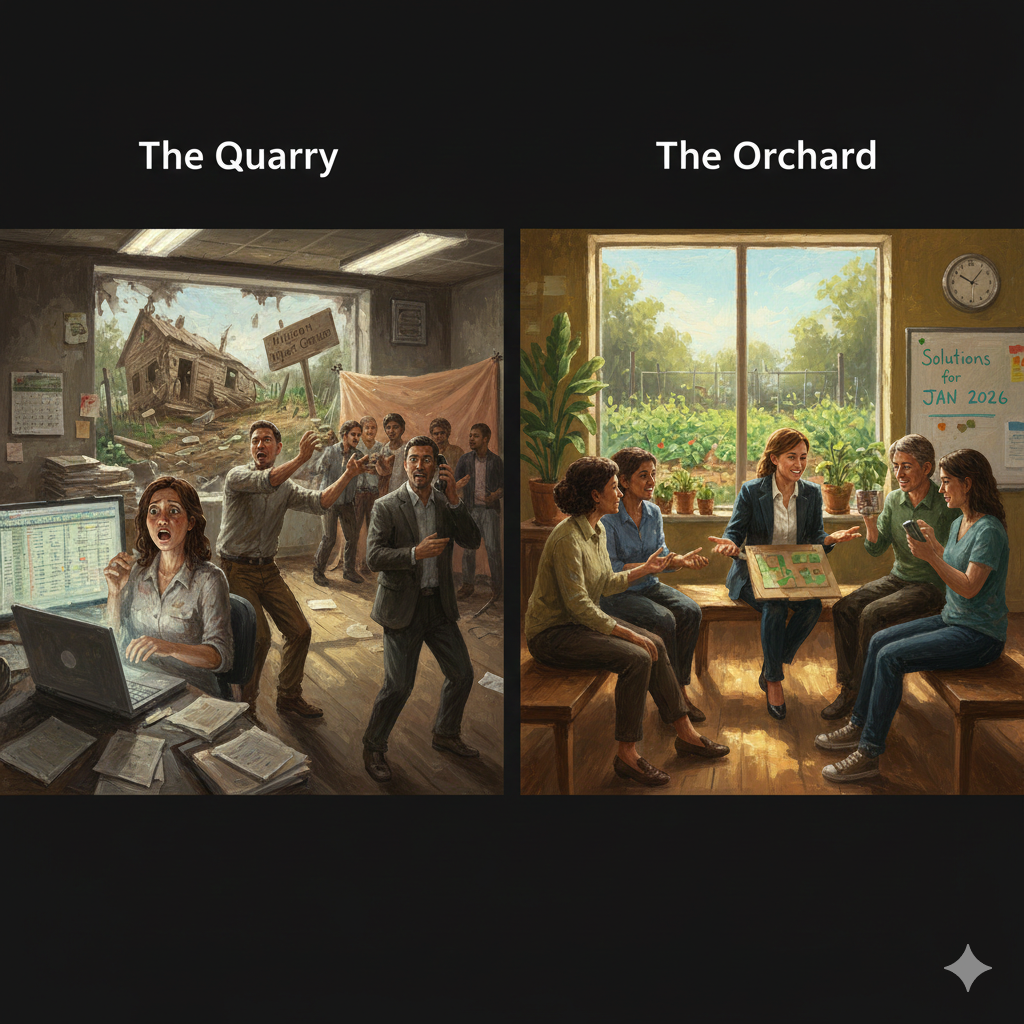
The Quarry Nonprofit:
- Optimize for: Grant renewal, donor satisfaction, board optics
- Measure: Service volume, cost per client, compliance documentation
- Decision Framework: “Will this look good in the annual report?”
- Worker Treatment: Expendable inputs toward measurable outputs
- Innovation Posture: Risk-averse (might miss KPI targets)
- Mission Creep: Follows funding streams, not community need
The Orchard Nonprofit:
- Optimize for: Long-term community transformation, worker sustainability
- Measure: Quality of relationships, systemic change indicators, worker well-being
- Decision Framework: “Does this serve our deepest purpose?”
- Worker Treatment: Essential stakeholders whose insight drives strategy
- Innovation Posture: Experimental (tests better ways to achieve mission)
- Mission Integrity: Shapes funding strategy around purpose, not vice versa
That night during the Florida storm, the choice was clear: operate from quarry extraction logic (maximize visible output, regardless of human cost) or orchard cultivation logic (protect the people who make mission possible, trust their judgement about when conditions are unsafe).The directive to keep workers exposed in dangerous weather wasn’t an outlier. It was a symptom of systemic dysfunction: when organizations serve their measurement systems rather than their missions, people become disposable.
3. The Innovation Stranglehold
Perhaps the most insidious cost of measurement theater is its impact on innovation. When organizations are bound to predetermined KPIs and donor expectations, they lose the freedom to experiment with more effective approaches.
Consider these common scenarios:
The Better Method You Can’t Use: A homeless services organization discovers that providing stable housing first (before requiring sobriety or employment) dramatically improves long-term outcomes. But their grants measure “program completion rates” based on sequential steps through treatment. Housing First would blow up their KPIs, even as it better serves their mission.
The Honest Conversation You Can’t Have: A youth development program realizes that 40% of their participants would be better served by a completely different approach—but admitting this to donors feels like failure. So they keep running a program that’s misaligned for nearly half their kids, because changing course might look like “mission drift.”
The Safety Protocol You Can’t Implement: Frontline workers identify that evening hours in a particular neighborhood have become dangerous. But grant deliverables require X number of evening contacts. Leadership faces an impossible choice: meet the measurement target or protect worker safety.

This is the quarry mindset at work: predetermined extraction targets override adaptive intelligence. The measurement system becomes more important than the mission it was designed to serve.
4. The Hidden Cost: Burning Out Your Best People
There’s a direct line between measurement theater and the nonprofit burnout epidemic (95% of nonprofit leaders report burnout concerns—a crisis we’ve examined extensively in our research on extractive leadership models).
When frontline workers are treated as measurement-production units rather than mission-critical stakeholders, several predictable patterns emerge:
Moral Injury: Workers entered nonprofit work because they care about the mission. When they’re asked to prioritize optics over impact, to risk safety for appearances, to game metrics instead of serve people—this creates profound cognitive dissonance. They’re being asked to betray the values that brought them to the work.
Expertise Dismissal: Frontline workers often have the clearest understanding of what’s working and what isn’t. They see the gap between measured outputs and actual outcomes. But in quarry organizations, their insights are rarely solicited. “Just hit your numbers” replaces “What are you learning?”
Sustainable Pace Impossible: When KPI targets are set without input from those doing the work, they’re often unrealistic. Workers exhaust themselves trying to meet arbitrary benchmarks, knowing that failure might cost the organization funding—and their colleagues, jobs.
Innovation Suppression: The workers closest to the mission are often the most creative problem-solvers. But in measurement-obsessed cultures, they learn quickly: novel approaches that might better serve mission but don’t fit measurement categories are career-limiting. Conformity is rewarded. Creativity is punished.
That Florida storm wasn’t about weather. It was about which stakeholders matter in organizational decision-making. And when worker safety comes second to donor perception, you’ve told your team exactly where they rank in your stakeholder calculus.
The organization lost three frontline workers within two months of that incident, including me. Not because of the storm. But, rather, what the storm revealed about whose well-being actually mattered
5. The Stakeholder Capitalism Alternative
Milton Hershey provides a better model—not just for corporate leadership, but for mission-driven work. During the Great Depression, when most organizations were contracting, Hershey went on a building spree. Why? To keep workers employed. To sustain the community. To maintain organizational capacity for when conditions improved.
This wasn’t charity. It was stakeholder capitalism: the recognition that organizational health depends on the flourishing of everyone connected to the mission—workers, clients, community, long-term donors who care about impact over optics.
Translated to modern nonprofits, stakeholder leadership means:
Worker Safety and Well-Being as Non-Negotiable
No KPI, grant deliverable, or donor perception justifies putting workers at risk. Full stop. Organizations that can’t operate this way need to renegotiate their grants, educate their donors, or change their models.
Frontline Wisdom Drives Strategy
The people closest to the work should have significant input into what gets measured and how. If there’s a gap between their lived experience and what the spreadsheet says, trust the humans, not the data.
Innovation Space Protected
Build into every program budget the capacity to experiment. Allocate 10-20% of effort toward testing better approaches, even if they don’t fit current measurement frameworks. Document learnings rigorously, then use this evidence to negotiate with funders.
Honest Stakeholder Communication
When measurement systems and mission come into conflict, have the courage to tell funders and donors the truth. Many will respect the integrity. Those who don’t weren’t aligned with your mission anyway.
Long-Term Capacity Over Short-Term Metrics
Invest in worker development, organizational learning, community relationship-building—even when these don’t produce immediate measurable outputs. These are orchard activities: cultivating soil and roots that will yield harvest for generations.
6. Practical Steps: From Quarry Extraction to Orchard Cultivation
For nonprofit and NGO leaders feeling trapped in the measurement theater cycle, here are concrete steps toward stakeholder-centered operations:
Short-Term (Next 90 Days):
1. Audit Your Decision-Making: Review the last ten significant decisions your leadership team made. For each, identify: Who was prioritized? Workers, clients, funders, board, community, long-term mission? Patterns will emerge.
2. Create Safety Protocols: Establish non-negotiable boundaries around worker safety and well-being. Document these. Share them with funders and board. If anyone objects, you’ve identified a stakeholder misalignment that needs immediate attention.
3. Install Feedback Loops: Create regular, structured opportunities for frontline workers to share what they’re learning—especially when it contradicts official metrics. Protect these conversations from being co-opted into positive spin for donors.
Medium-Term (Next 6-12 Months):
4. Renegotiate Measurement Frameworks: Approach your top three funders with this proposition: “We want to be accountable for real impact, not measurement theater. Can we collaborate on metrics that actually track mission fulfillment?” Many funders are hungry for this conversation.
5. Build Innovation Capacity: Designate specific time/budget for experimentation. Use Design Thinking methodology (see Framework 3 in our approach) to prototype new approaches with community input, test them in low-risk settings, and document learnings.
6. Educate Your Board: If board members are pushing for shareholder-style metrics, this is a teaching opportunity. Share the research on stakeholder capitalism’s superior returns. Help them understand that long-term mission impact requires different measurement approaches than quarterly earnings.
Long-Term (1-3 Years):
7. Diversify Funding Strategically: Reduce dependence on any single funder or funding stream that forces mission compromise. Build relationships with donors who care about long-term impact over short-term optics.
8. Document and Share Your Model: As you shift toward stakeholder-centered operations, rigorously document outcomes (including qualitative transformation indicators). Publish your findings. This creates cover for other organizations to follow suit.
9. Join or Create Learning Communities: Connect with other mission-driven leaders making this transition. Share challenges, strategies, and evidence. The sector shifts fastest when leaders support each other’s courage.
7. The Storm Will Come
That Florida storm wasn’t unique. Every mission-driven organization will face moments when measurement pressure conflicts with mission integrity, when donor optics compete with worker safety, or when short-term KPIs threaten long-term impact.
These moments reveal who we actually are—not who we claim to be in our mission statements.
Are we quarries extracting measurable output from expendable humans? Or are we orchards cultivating sustainable ecosystems where workers, clients, and communities can all flourish?
The choice isn’t between accountability and care. It’s between extractive measurement (designed to satisfy funders and board) and regenerative measurement (designed to improve mission impact and stakeholder well-being).
Organizations that choose the orchard path face real challenges. Some grants may be lost. Some donors may walk. Some board members may resist. This is painful.
But here’s what they gain: workers who bring their full creativity and commitment to the mission. Innovation that actually improves outcomes. Community trust built on integrity rather than performance. Long-term resilience instead of burnout churn. And the possibility of genuine transformation rather than photographable compliance.
The measurement theater industrial complex is powerful. But it’s not inevitable.
Every time a leader says “worker safety comes first, even if it affects our metrics,” they’re cultivating different soil. Every time an organization tells a funder “we need flexibility to innovate toward mission, not rigidity toward compliance,” they’re planting different seeds. Every time a board chooses long-term stakeholder flourishing over short-term optics, they’re watering a different kind of growth.
This is the shift from quarry to orchard. From extraction to cultivation. From shareholder pressure to stakeholder prosperity.
It’s the work of a generation. And it starts with leaders who have the courage to ask: What are we actually cultivating here?
References
Brown, B. (2018). Dare to Lead: Brave Work. Tough Conversations. Whole Hearts. Random House.
Gelles, D. (2022). The man who broke capitalism: How Jack Welch gutted the heartland and crushed the soul of corporate America—and how to undo his legacy. Simon & Schuster.
Gallup. (2023). State of the Global Workplace Report.
Kotter, J. P., & Heskett, J. L. (1992). Corporate Culture and Performance. Free Press.
Society for Human Resource Management (SHRM). (2022). The Real Costs of Recruitment.
Watson Wyatt. (2002). WorkUSA Study: The Relationship Between Trust and Financial Performance.Zak, P. J. (2017). The Neuroscience of Trust. Harvard Business Review, 95(1), 84-90.

The Leadership Blind Spot Costing You Innovation: What Carl Jung Knew About the Ego That Most Executives Don’t
You Don’t Know Yourself as Well as You Think
Most executives operate under a dangerous assumption: I’m self-aware. I see the full picture. I know what I’m doing.But Carl Jung, the pioneering psychologist who mapped the hidden architecture of human consciousness, would call that claim ego inflation—the mind’s most predictable trap.
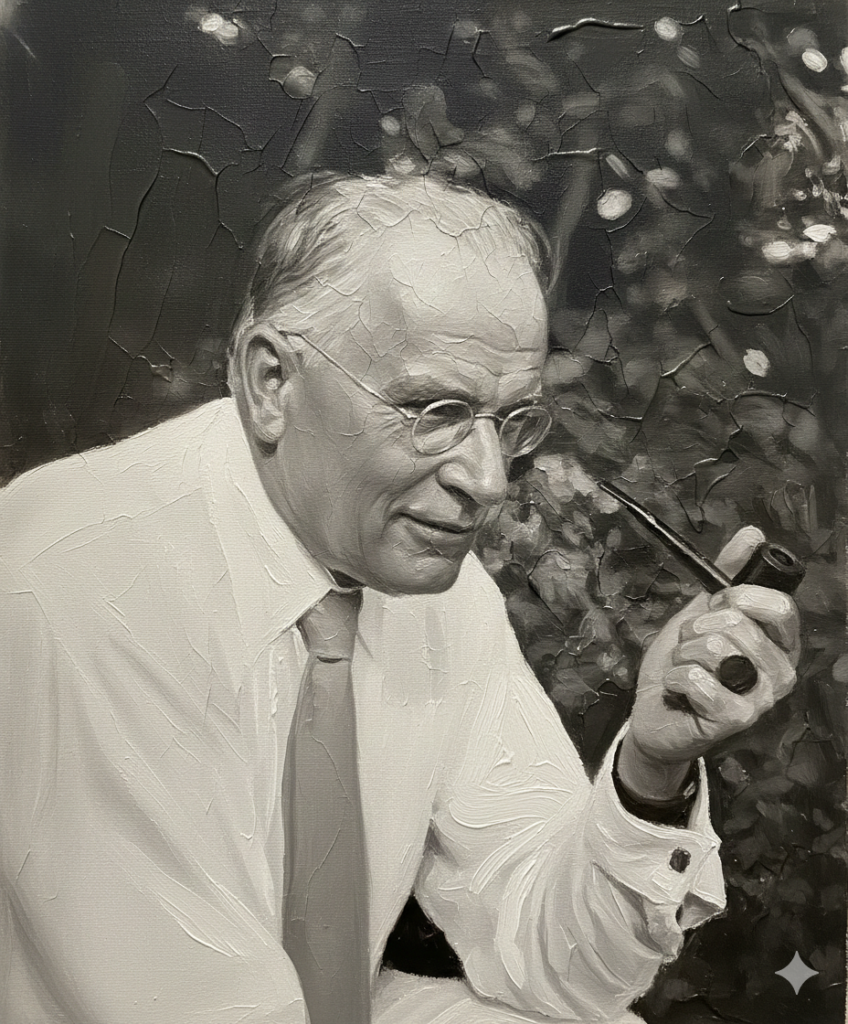
Jung described the ego as the “center of consciousness”—the part of you that experiences being “I.” It filters reality, makes decisions, and maintains your sense of identity across time. It’s the command center of your awareness.
But here’s what most leaders miss: your ego is only about 10% of who you are.
Jung was blunt about this: “The ego is only a bit of consciousness that floats upon an ocean of dark things.” Your unconscious drives, unexamined assumptions, repressed emotions, and cultural conditioning govern far more of your behavior than your conscious mind realizes.
Translation: You have massive blind spots. And those blind spots directly create toxic culture, strategic failures, and burned-out teams.
The Quarry Leadership Model: When “It” Destroys Value
Jack Welch’s GE exemplified what Jung called an ego-inflated system—one that mistakes its limited perspective for total reality.
Welch saw employees as “it”—objects to optimize and discard. His “rank and yank” system treated people as interchangeable units in a shareholder-maximization machine. The ego driving that system was brilliant, hyper-rational, and catastrophically incomplete.
Why? Because rigid egos repress what threatens them.
Jung identified the Shadow—the unconscious repository of everything the ego refuses to acknowledge. For Welch’s GE, the Shadow contained:
- Worker dignity
- The value of long-term trust
- Innovation requiring psychological safety
- Stakeholder relationships that create sustainable wealth
All of it was dismissed as “soft.” And when 40,000 employees were laid off while Welch collected $417 million in retirement, the shadow erupted: GE lost $600 billion and was erased from the Dow after 110 years.
The Quarry Ego sees “it” everywhere. Resources to extract. Metrics to hit. People to rank. And because it only sees “it,” it cannot perceive the living beings—the “thou”—who actually generate innovation and value.
The Shift That Changes Everything: “It” vs. “Thou”
Joseph Campbell, the mythologist who studied humanity’s deepest stories, articulated the psychological shift required for generative leadership:
“The ego that sees an ‘it’ is not the same ego that sees a ‘thou.'”
What does this mean?
The “It” Perspective:
- Detached, transactional, utilitarian
- Views people and nature as objects to use
- Enables extraction, domination, destruction
- Result: Short-term gains, long-term collapse
The “Thou” Perspective:
- Empathetic, relational, sacred
- Views people and nature as beings worthy of respect
- Enables partnership, reciprocity, regeneration
- Result: Long-term flourishing, sustained innovation
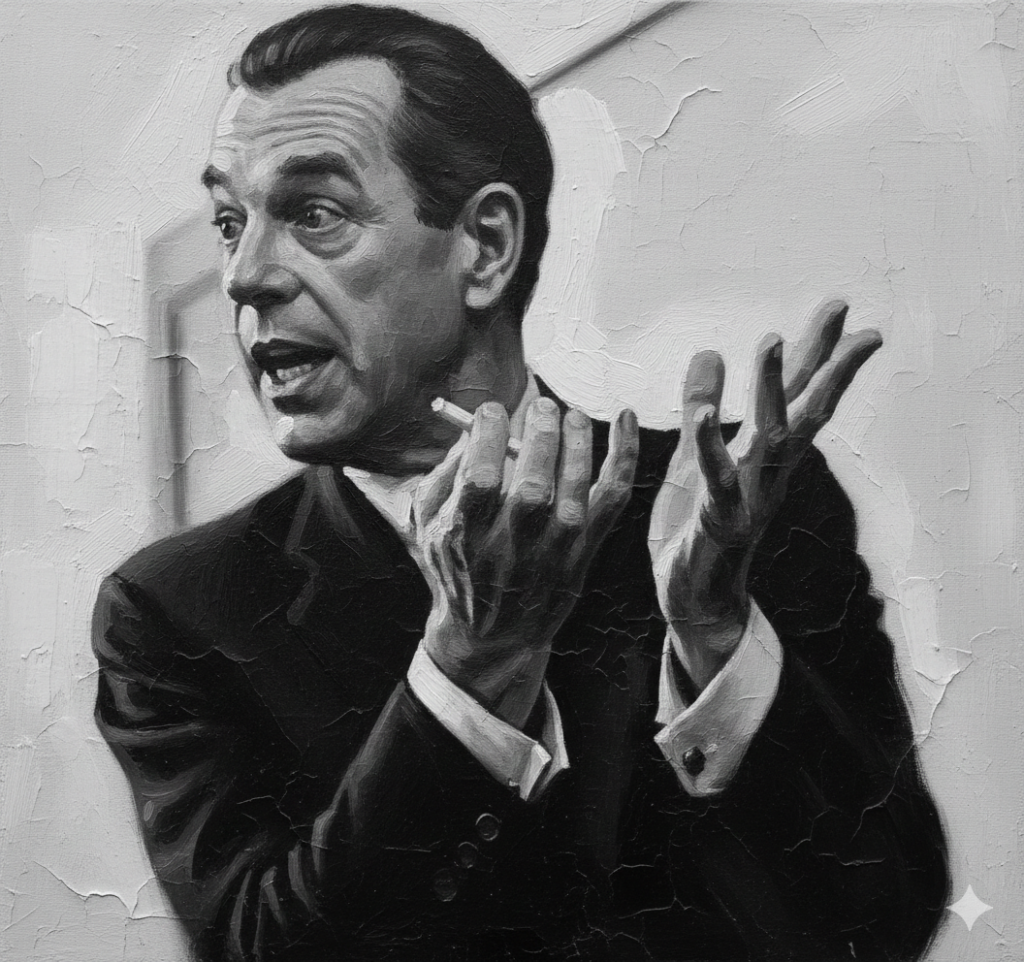
Campbell explained: “Your whole psychology changes” based on this shift. When you see the world as “it,” you can clearcut forests, rank and yank workers, or bomb villages. When you see the world as “thou,” you recognize the dignity and sacred worth in all beings—and you cannot act in the same extractive ways.
Milton Hershey embodied “thou” leadership.
During the Great Depression, while competitors slashed payrolls, Hershey launched a massive building campaign to keep workers employed—not to maximize quarterly earnings, but because he saw them as human beings whose families and dignity mattered. He built a town, a school, and a trust structure that protects stakeholders in perpetuity.
The result? Hershey remains one of the world’s most trusted brands 130+ years later.
The difference was not intelligence. It was consciousness.
Why Your Ego Can’t Get You Where You Need to Go
Here’s the uncomfortable truth: your ego cannot expand itself without help.
Your conscious mind operates in a closed loop. It sees what it expects. It filters for confirming evidence. It represses what threatens stability. This isn’t a character flaw—it’s neurobiology. Your brain conserves energy by automating perception.
For leaders, this creates three predictable traps:
1. The Persona Trap
You over-identify with your professional mask (CEO, Visionary, Expert) and lose access to vulnerability, uncertainty, and relational need. You become brittle. Your teams walk on eggshells. Innovation dies because breakthroughs require admitting you don’t have all the answers.
2. The Shadow Trap
Everything you repress—fear, grief, doubt, need for connection—doesn’t disappear. It leaks out sideways: passive aggression, blame-shifting, emotional volatility, sudden collapses. Leaders who deny their Shadow create toxic cultures because unacknowledged material acts out through unconscious behavior.
3. The Inflation Trap
Ego inflation happens when leaders mistake their limited perspective for omniscience. “I see the market clearly. I know what’s best.” But Jung warned: inflation always precedes a fall. When egos refuse to acknowledge limits, reality forces correction—usually catastrophically.
Quarry leadership is ego inflation at scale. It denies complexity, represses relational needs, and extracts until collapse.
Orchard leadership recognizes ego’s limits—and invites something larger.
The P.E.P. Framework: Expanding Your Operating System
Jung believed individuation—integrating unconscious material into consciousness—was central to human maturation. For leaders, this isn’t therapy-speak. It’s business-critical infrastructure.
You cannot lead complex organizations with a defensive, rigid ego. You need expanded executive function: the ability to hold paradox, integrate shadow material, tolerate ambiguity, and shift perspectives.
Enter ASQ’s P.E.P. Framework: Perspective → Experience → Philosophy.
It’s a repeating spiral that moves leaders from fragmentation (ego defending against reality) to coherence (ego serving the larger Self).
PERSPECTIVE (Step Back)
Core Function: Opening for Transformation
Pause automatic reactivity. Notice your ego’s defensive patterns. Where are you treating people, challenges, or complexity as “it” instead of “thou”?
Practical Application:
- Before major decisions, ask: What am I not seeing? What perspective am I dismissing?
- Implement 90-second breathing protocols before high-stakes meetings
- Track emotional triggers: When do you shut down feedback? When do you over-function?
EXPERIENCE (Step Through)
Core Function: The Crucible of Transformation
Engage with the discomfort. Investigate unconscious material driving behavior. What Shadow content are you repressing? What relational needs are you denying?
Practical Application:
- Conduct stakeholder listening tours: What do employees, customers, partners experience that you cannot see from your position?
- Journal on Campbell’s question: Where am I seeing “it” when I should be seeing “thou”?
- Engage peer coaching where your Persona can be challenged safely
PHILOSOPHY (Step Forward)
Core Function: Integration and Meaning-Making
Extract wisdom from experience. Integrate new awareness into action. Shift from ego-as-hero (controlling outcomes) to ego-as-servant (facilitating emergence).
Practical Application:
- Redesign decision-making structures to include voices you previously filtered out
- Experiment with stakeholder-first metrics alongside shareholder returns
- Model vulnerability: Share what you’re learning, where you were wrong, how you’re evolving
Campbell’s Insight: The Philosophy stage is where the shift from “it” to “thou” solidifies—and it changes everything. Employees become partners. Customers become community. Competitors become ecosystem collaborators.
This is not soft leadership. This is sophisticated leadership.
The Spiral: Why One Cycle Isn’t Enough
Most leadership development treats transformation as a destination. You “complete” a program and you’re done.
P.E.P. is a spiral, not a ladder.
You move through Perspective-Experience-Philosophy at one level of complexity, integrate that learning, and immediately encounter a new edge. Jung called this circumambulation—walking around the center, seeing it from new angles, spiraling closer to wholeness.
Milton Hershey’s Spiral:
Hershey didn’t start fully formed. His early ventures failed repeatedly. But each failure became a P.E.P. cycle:
- Perspective: Failure forces reflection
- Experience: What did I miss? What pattern keeps repeating?
- Philosophy: Try a different approach, informed by shadow integration
By the time he built the chocolate empire, he had spiraled through enough cycles to see employees as “thou,” design for stakeholder flourishing, and structure governance protecting mission beyond his lifetime.
Jack Welch never spiraled. He perfected one ego strategy—domination through metrics—and rode it until collapse.
Why Leaders Resist the Spiral
If P.E.P. is so effective, why don’t more leaders use it?
Because the ego hates Perspective (the Pause).
Jung observed that the ego’s primary function is maintaining stability. Pausing threatens that. Exploring shadow material is uncomfortable. Philosophy (integration) requires admitting you were wrong.
And American business culture—steeped in Welchism—rewards the opposite:
- Decisive action over reflection
- Certainty over curiosity
- Control over collaboration
- Extraction over cultivation
The result? Leaders trapped in ego inflation, unable to see blind spots, surrounded by teams too afraid to tell the truth.
This is the Quarry’s terminal diagnosis: ego rigidity in a world demanding adaptive complexity.
The Orchard Invitation: Ego in Service of Something Larger
Jung’s ultimate vision was individuation: the ego evolving from defensive hero to conscious servant of the larger Self—integrating conscious and unconscious, personal and collective, rational and relational.
For leaders, this means:
- Your role is not having all answers but creating conditions where answers emerge
- Your job is not controlling outcomes but cultivating soil where innovation grows
- Your identity is not fixed but continuously evolving through relationship and integration
This is Orchard leadership.
It doesn’t mean abandoning metrics, strategy, or accountability. It means expanding your operating system so you can hold complexity without collapsing into defensive simplicity.
The data is clear:
- Stakeholder-focused companies: 682% revenue growth vs. 166% shareholder-only (Kotter & Heskett, 1992)
- High-trust organizations: 286% higher shareholder returns (Watson Wyatt, 2002)
- Engaged employees: 21% higher profitability (Gallup, 2016)
Seeing “thou” instead of “it” is not just morally superior—it’s economically superior.
But you cannot decide to see “thou.” You must expand your ego’s capacity to perceive it.
And that requires the spiral.
References
Campbell, J. (1988). The power of myth (B. Moyers, Interviewer). Doubleday.
D’Antonio, M. (2006). Hershey: Milton S. Hershey’s extraordinary life of wealth, empire, and utopian dreams. Simon & Schuster.
Gallup. (2016). The relationship between engagement at work and organizational outcomes. Gallup Press.
Gelles, D. (2022). The man who broke capitalism: How Jack Welch gutted the heartland and crushed the soul of corporate America—and how to undo his legacy. Simon & Schuster.
Jung, C. G. (1968). The archetypes and the collective unconscious (2nd ed., R. F. C. Hull, Trans.). Princeton University Press. (Original work published 1959)
Kotter, J. P., & Heskett, J. L. (1992). Corporate culture and performance. Free Press.
Siegel, D. J. (2012). The developing mind: How relationships and the brain interact to shape who we are (2nd ed.). Guilford Press.Watson Wyatt Worldwide. (2002). WorkUSA 2002: Weathering the storm—A study of employee attitudes and opinions. Watson Wyatt.