The Initiative Graveyard: Why Mission-Driven Organizations Keep Starting Things They Cannot Finish

When the problem isn’t the plan — it’s the system underneath the plan
The Monday morning that repeats itself

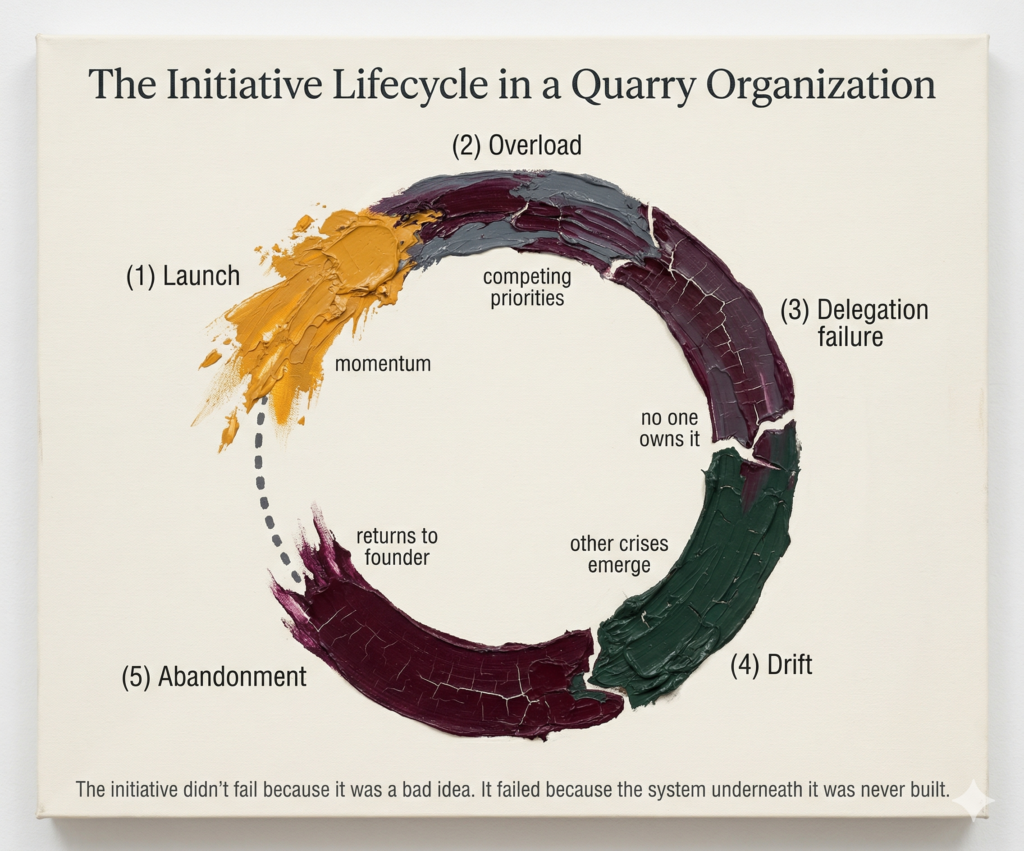
The executive director has seen this before. A new initiative launches with genuine energy — a program expansion, a staff development series, a data infrastructure project, a community partnership that could change the organization’s reach. The planning session is productive. The whiteboard fills up. People leave energized.

Six weeks later, the initiative is living in a folder no one opens.

This is not a story about poor planning. It is not a story about uncommitted staff or unrealistic timelines. It is a story about a structural condition that affects nearly every mission-driven organization operating under resource pressure — and it has a name.

The Creative System under extraction

ASQ’s Fractal Coherence Methodology maps four integrated systems that operate at both individual and organizational scale simultaneously. The Creative System is the domain of agency, generativity, and forward design — the capacity of a person or an organization to imagine something that does not yet exist and bring it into being with coherent effort over time.

In a healthy Creative System, ideas are resourced, ownership is distributed, and the organization has enough structural slack to absorb the demands of building something new alongside running what already exists. New initiatives move through a development arc: conception, design, delegation, iteration, stabilization.

In a Quarry organization — one running on extraction, heroism, and founder-dependency — the Creative System operates under a specific and predictable distortion. The capacity to conceive is intact. The capacity to complete is not. Leadership generates ideas faster than the system can absorb them. Initiatives launch without clear ownership. Ownership without authority produces the same result as no ownership at all. Structural slack does not exist because every available unit of human capacity is already committed to keeping what is running from stopping.

The whiteboard fills. The folder stays closed.

What this looks like from inside

There is a recognizable texture to Creative System failure in a mission-driven organization. It rarely announces itself as a systems problem. It announces itself as a people problem.

The executive director concludes the team lacks follow-through. The team concludes leadership lacks focus. Both observations contain partial truth. Neither observation names the structural condition underneath them.

Gallup’s research on employee engagement is instructive here: organizations where employees report that their opinions do not count, their roles lack clear ownership, and new ideas disappear after announcement show predictable disengagement signatures within 18 months — not because staff do not care, but because the system has taught them that creative investment carries no return (Gallup, 2023). Staff in a Quarry Creative System do not stop caring. They stop launching. Self-protection, not apathy, explains the silence in the room when the next initiative is announced.

The executive director, sitting at the head of the table, may read that silence as resistance. It is, in fact, data.

The fractal pattern

This is where the Quarry frame becomes most precise. The Creative System failure does not begin with the organization. It begins — and replicates — at the leadership scale.

Most executive directors leading mission-driven organizations carry what might be called a creation without completion pattern in their own cognitive and operational style. The drive to generate — new programs, new partnerships, new approaches — is one of the qualities that made them effective in earlier roles. In the executive director position, that generative capacity is operating inside a system that cannot receive it at full volume.

The pattern: the leader generates faster than the organization can absorb. The organization, unable to complete what has been started, produces visible dysfunction. The leader, reading that dysfunction as evidence that more initiative is needed, generates more. The cycle accelerates. The graveyard grows.

This is not a character flaw. It is a fractal expression of a Creative System that has never been designed — only inherited.

The structural cause

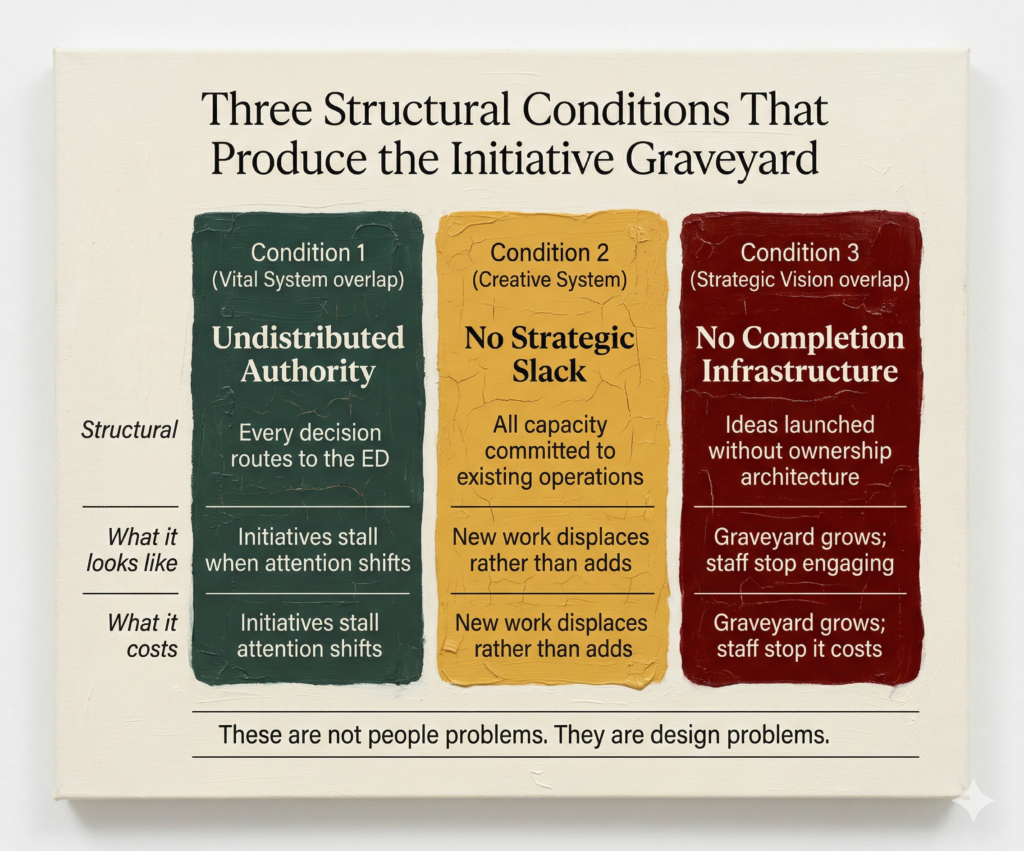
Three architectural conditions produce Initiative Graveyard syndrome in mission-driven organizations. They are predictable, diagnosable, and structural:

1. Distributed authority has never been built. The executive director holds decision rights that should belong to program directors, operations leads, and team managers. New initiatives require the ED’s involvement at every inflection point — which means they move only as fast as the ED can move, and they stall when the ED’s attention goes elsewhere.

2. Strategic slack does not exist. The organization is running at or above capacity on existing commitments. Every staff member’s calendar is full. New initiatives must be absorbed into a system with no available capacity, which means they displace existing work rather than adding to it — producing the perception of chaos rather than growth.

3. The Creative System has no infrastructure. There is no formalized process for moving an idea from conception to ownership to delivery accountability. Initiatives are announced but not designed. Design without infrastructure is aspiration, not execution.
These three conditions are not caused by individual failure. They are the predictable output of an organization that has grown through heroism rather than architecture.
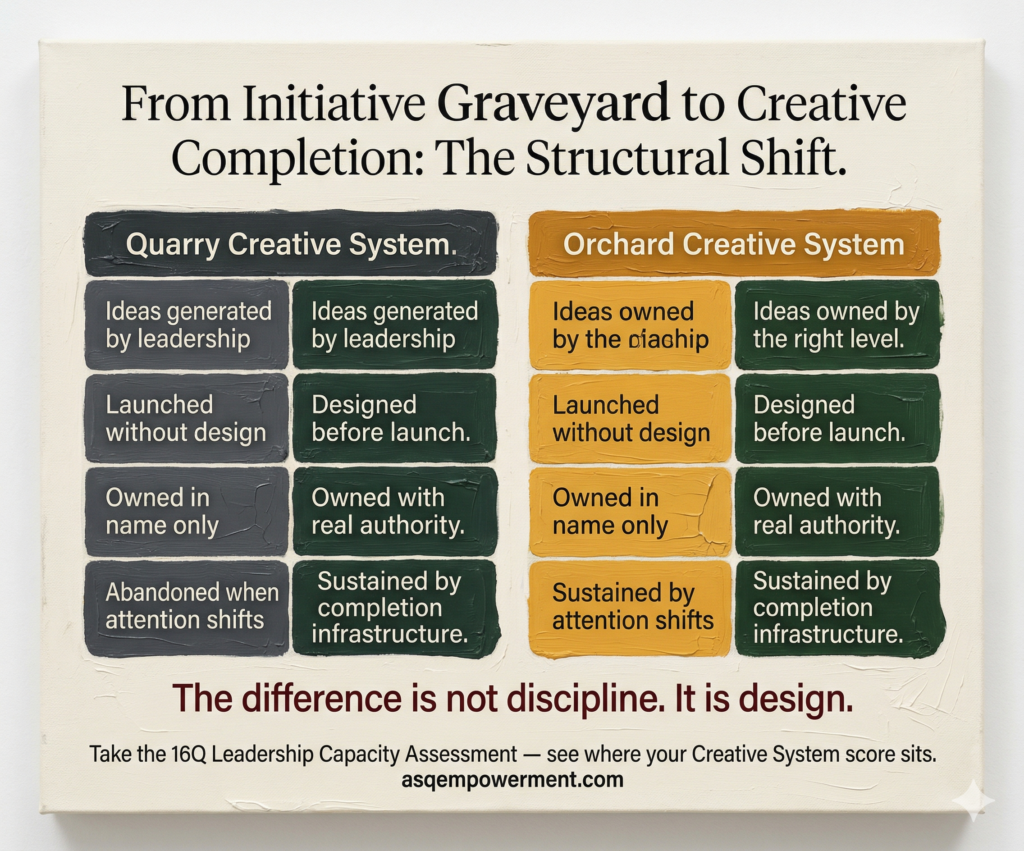
The difference between a Quarry and an Orchard Creative System

An Orchard organization does not generate fewer ideas. It generates ideas inside a system designed to receive them.

The distinction is architectural, not motivational. An executive director with a well-functioning Creative System does not have more discipline or more restraint. They have built — deliberately or through good guidance — the structural conditions that allow initiative to move from conception to completion without routing everything through a single human bottleneck.

Distributed authority means program directors can own their initiatives with genuine decision rights. Strategic slack means the organization has built some capacity reserve — not abundance, but room to absorb what is new without displacing what is running. Completion infrastructure means every initiative enters a formalized development process: named owner, defined scope, milestone accountability, and a review cadence that catches drift before it becomes abandonment.

The whiteboard in the Orchard still fills. But the folder gets opened.

What the data shows about sustainable organizational creativity

Research on organizational innovation in resource-constrained nonprofit environments consistently identifies the same bottleneck: the constraint is not ideation, it is structural capacity for execution. A longitudinal study of mission-driven organizations found that those with documented decision-rights frameworks and formalized initiative management processes were 2.6 times more likely to successfully implement strategic priorities than those without such frameworks, regardless of budget size (Battilana & Lee, 2014). The constraint, in other words, is never the mission. It is the architecture.

This finding maps precisely onto what ASQ observes in the Creative System across the organizations it serves. The ideas are not the problem. The leaders generating them are not the problem. The structure available to receive and process them is where the dysfunction lives — and where the intervention belongs.

The path forward

The initiative graveyard is not evidence that your organization cannot execute. It is evidence that execution architecture has not yet been built.

The diagnostic work begins with one question: Does your organization have a formalized process for moving from idea to ownership to completion accountability — or does each new initiative invent its own process from scratch? If the answer is the latter, you are not looking at a people problem or a commitment problem. You are looking at the predictable output of a Creative System that has never been designed.

That design is not complex. It is architectural.
If the pattern described in this article is familiar — if your organization has a whiteboard full of good ideas and a folder full of unfinished ones — the Leadership Capacity Assessment is a useful starting point. It takes five minutes and maps where your organization’s Creative System score sits relative to the other three systems. The results are specific. Book a conversation with Jessie Ferreira at yoursoulcycle.com if you want to understand what those results mean for your organization.

#NonprofitLeadership #ExecutiveDirector #OrganizationalHealth #MissionDriven #LeadershipDevelopment Instagram: #NonprofitLife #ExecutiveLeadership #OrchardLeadership #LeadershipCoherence #ASQEmpowerment

References

Battilana, J., & Lee, M. (2014). Advancing research on hybrid organizing — insights from the study of social enterprises. Academy of Management Annals, 8(1), 397–441. https://doi.org/10.5465/19416520.2014.893615

Gallup, Inc. (2023). State of the global workplace: 2023 report. Gallup Press. https://www.gallup.com/workplace/349484/state-of-the-global-workplace.aspx

Gelles, D. (2022). The man who broke capitalism: How Jack Welch gutted the heartland and crushed the soul of corporate America — and how to undo his legacy. Simon & Schuster.

Meadows, D. H. (2008). Thinking in systems: A primer. Chelsea Green Publishing.Senge, P. M. (1990). The fifth discipline: The art and practice of the learning organization. Doubleday/Currency.

The Orchard Leader: What Regenerative Leadership Actually Looks Like in Practice

The leader who has built a regenerative organization is not the one who works less; it is the one whose absence the organization no longer fears.

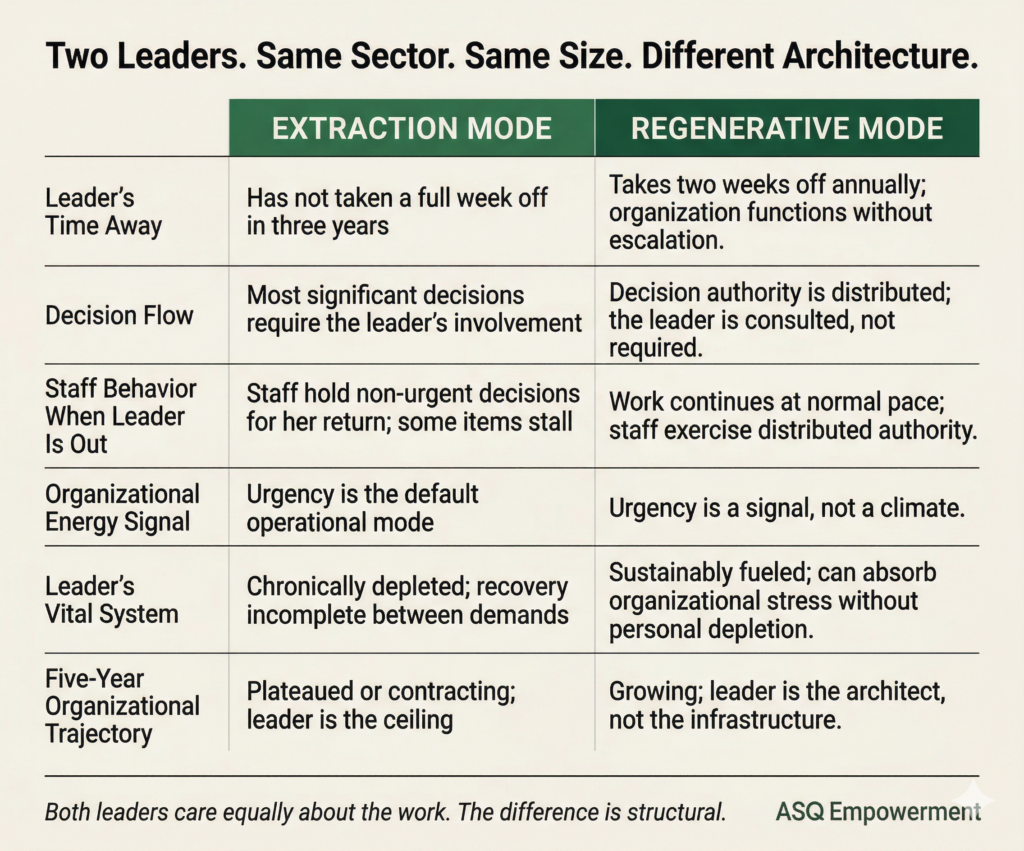
She has not taken a full week off in three years.

This is not a complaint; she has never framed it that way. It is simply the operational reality of running a mid-size organization alone at the center of every significant decision: grant renewal negotiations, program director conflicts, board chair communications, and the facilities emergency that came up in November. Each time she has considered taking time, something has arisen that only she can handle.

She is proud of what she has built. She is also, by any honest measure, the single point of failure in it.

Two miles away, a leader running an organization of comparable size and budget has just returned from two weeks at her family’s place in the Florida Keys. Her deputy director handled the one significant decision that arose while she was gone. No phone calls. No emails marked urgent. She came back to a team that had, in her words, “just kept working.”

These two leaders are not separated by talent, commitment, or resources. They are separated by a structural distinction that most leadership development frameworks never name directly: one organization has a functioning Vital System, and one is operating on the permanent extraction of its most essential resource.

What the Vital System Actually Is

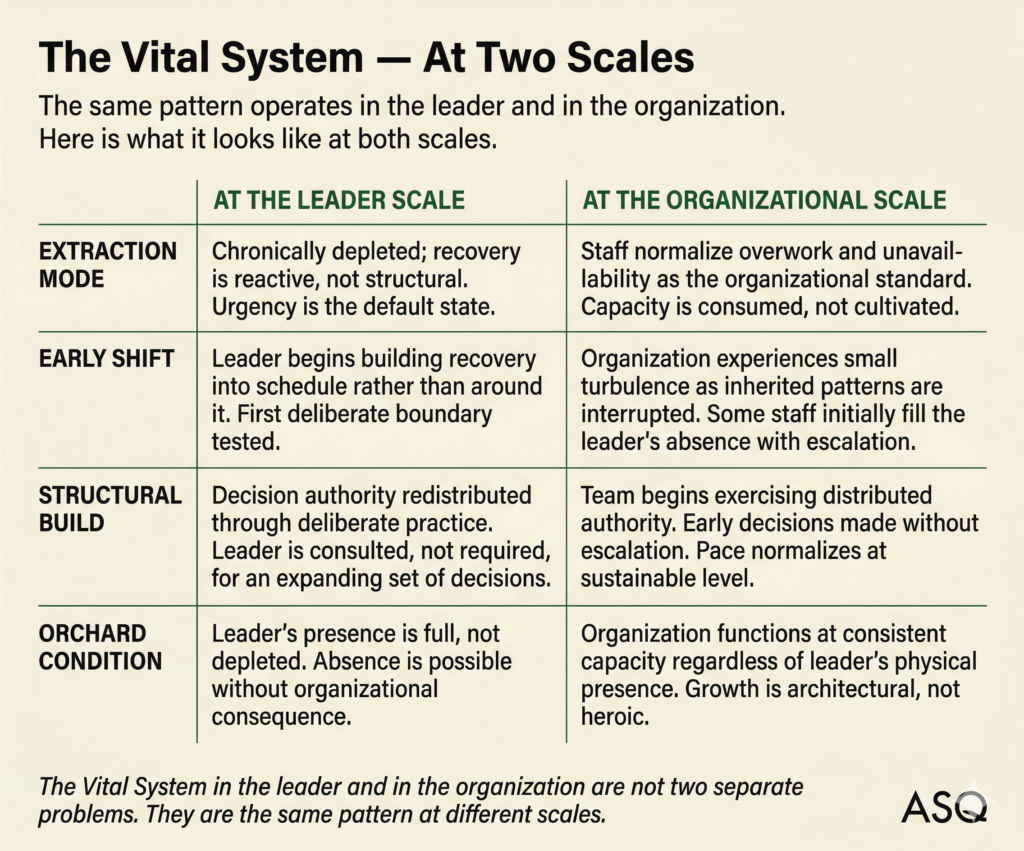
The Vital System is the first of ASQ’s Four Integrated Systems, and it is the one that makes all others possible. It governs the capacity for sustained, effective functioning: at the individual level, the leader’s physical and nervous system resources, her ability to recover between demands, and the quality of her presence under pressure. At the organizational level, it is the aggregate health of the people doing the work, the culture of pace, recovery, and sustainable output that either exists or is being consumed.

The precise fractal here: a leader whose Vital System is running in extraction mode, chronically depleted, urgency-addicted, functionally unable to be absent, will build an organization that replicates those conditions. Not because she intends to. Because the organization learns from what she models, and because heroic availability becomes the informal standard against which every staff member measures their own contribution.

This is not a metaphor. It is an organizational dynamics pattern documented consistently in the research literature on leader behavior and institutional culture. Leaders model the pace. The pace becomes the norm. The norm becomes the system (Loehr & Schwartz, 2003; Senge, 1990).

The Orchard leader, the one who came back from the Keys to a team that had kept working, did not produce this outcome by relaxing her standards. She produced it by building structures that distribute the organizational load before she needed to be absent.

What the Orchard Leader Built — and When

The distinction between the two leaders above is not a personality difference. It is not a matter of the first leader working too hard or the second leader working too little. It is a structural difference that was created years before the vacation happened.

The Orchard leader built three things that the extraction leader has not yet built:

Distributed decision authority. The Orchard leader has made explicit, in writing, through practice, through repeated correction of her own instinct to be consulted, the decisions her team is empowered to make without her. This is not a delegation checklist. It is the result of repeated, deliberate work to identify where her presence was structurally required versus where it had simply become habitual. The distinction matters: habitual centralization and structural necessity are not the same thing, and confusing them is how capable leaders become irreplaceable for the wrong reasons.

Vital System recovery built into the rhythm, not the exception. The extraction leader recovers when she can. The Orchard leader recovers on schedule. This difference, between recovery as an emergency measure and recovery as a structural feature of how she leads, shapes everything downstream. The quality of the decision made at the end of a long week by a depleted leader and the quality of the decision made by a leader who is genuinely rested are not equivalent. Pretending otherwise is a competence problem dressed as a commitment signal.

A team built to function, not to need. The extraction leader’s team has, over time, learned that the leader is the answer to ambiguity, to authority gaps, to decisions that feel risky to make alone. This is not the team’s failure; it is a structural outcome of how the organization was built. The Orchard leader has done the harder work of building a team that has been given real authority, experienced using it, and developed the judgment that comes from genuine responsibility. This does not happen through a single delegation exercise. It happens through years of consistent structural design.

Why “Working Less” Is the Wrong Frame

The most consistent misreading of regenerative leadership is that it describes a leader who works less. This is not accurate, and it is worth naming directly because the misreading produces the wrong response: leaders who are operating in extraction mode often respond to the concept of regenerative leadership by concluding it is not for them, that their organization, their sector, or their current phase of growth requires the extraction model for now.

The Orchard leader does not work less. She works differently, with a qualitatively different kind of presence, a different distribution of authority, and a deliberate structural relationship to her own capacity. The work required to build an Orchard organization is, in the early phases, significant. Identifying where decision authority can be distributed is not simple. Building a team’s capacity to exercise genuine authority takes time and requires tolerating mistakes that the extraction leader would never allow to happen, because she is always available to prevent them.

The distinction is not effort versus ease. It is extraction versus regeneration. In the extraction model, the organization’s capacity is borrowed from the leader’s reserves, and the debt accumulates. In the regenerative model, the organization’s capacity is cultivated structurally so that it does not depend on any single person’s heroic availability.

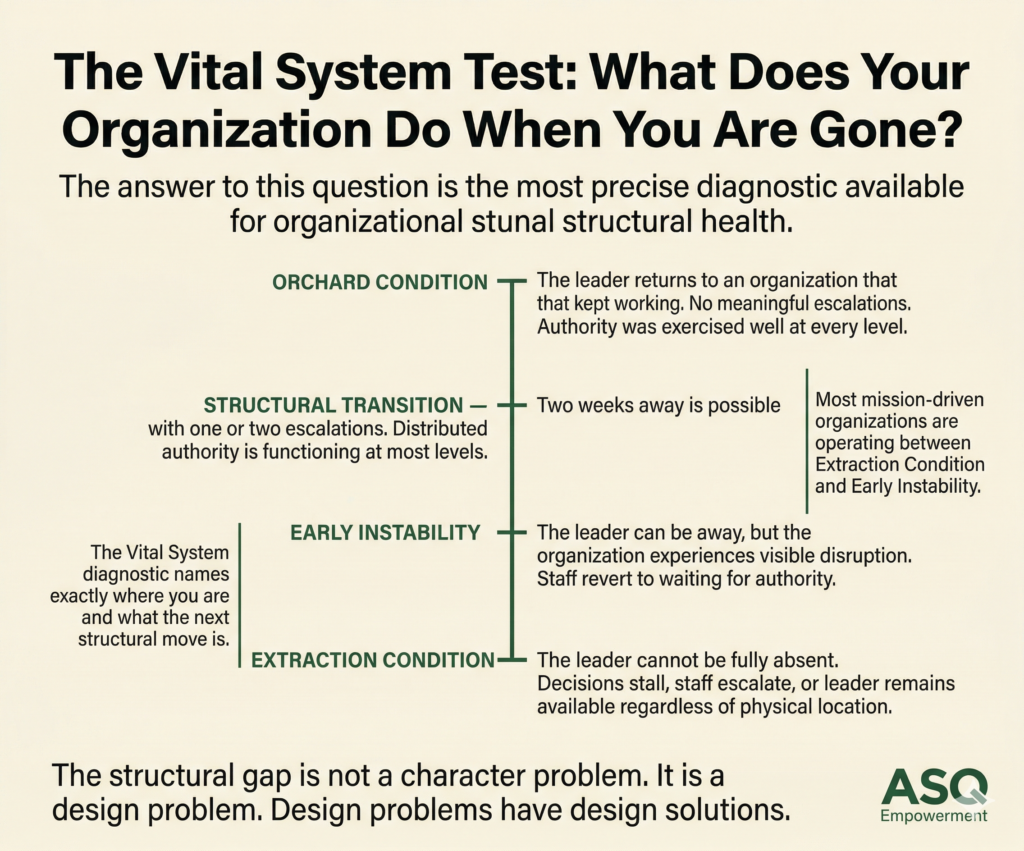
The test ASQ uses for Vital System health is not “how much time off does the leader take?” It is: “What happens when the leader is unavailable for two weeks?” That answer tells you more about an organization’s structural health than any strategic plan, mission statement, or board presentation.

If the answer is “we manage, but things slow down, and some decisions wait,” that is an early Orchard condition. Something is working.

If the answer is “honestly, it would be difficult to fully step away,” that is diagnostic information. Not a personal failing. A structural gap.

The leader who cannot be absent is not the leader who cares most. She is the leader whose organization has not yet been built to function without her. That is a structural condition, and structural conditions are addressable through structural means.

The discovery conversation with ASQ begins with one question: What would have to be true about your organization for you to take two weeks off without consequence? If you are ready to work through that question with someone who has a specific methodology for answering it, schedule a conversation with Dr. Jessie Ferreira at https://yoursoulcycle.com/asq-scheduling-calendar/

#RegenerativeLeadership #CoherentLeadership #FromQuarryToOrchard #LeadershipFromTheInsideOut #SustainableLeadership Instagram: #RegenerativeLeadership #CoherentLeadership #FromQuarryToOrchard #LeadershipFromTheInsideOut #OrganizationalCoherence

References

Loehr, J., & Schwartz, T. (2003). The power of full engagement: Managing energy, not time, is the key to high performance and personal renewal. Free Press.

Senge, P. M. (1990). The fifth discipline: The art and practice of the learning organization. Doubleday/Currency.
Meadows, D. H. (2008). Thinking in systems: A primer. Chelsea Green Publishing.

Collins, J. (2001). Good to great: Why some companies make the leap and others don’t. HarperBusiness.

Maslach, C., & Leiter, M. P. (2016). Understanding the burnout experience: Recent research and its implications for psychiatry. World Psychiatry, 15(2), 103–111. https://doi.org/10.1002/wps.20311

The Silent System: How Trust Breaks Down Before Anyone Names It

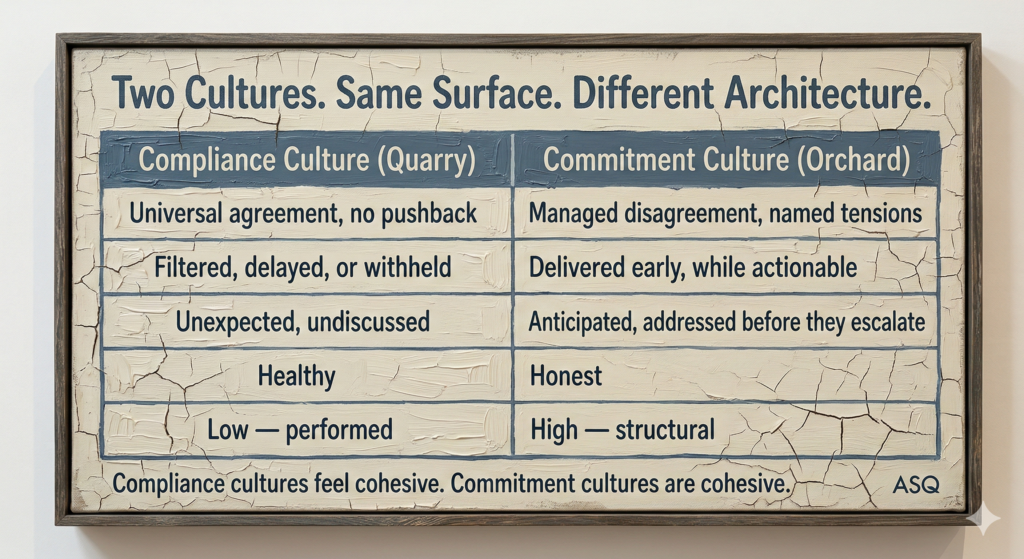
In mission-driven organizations, the most dangerous cultural pattern looks like cooperation.

The meeting went well.

No one raised a concern. No one questioned the timeline. The agenda moved cleanly from item to item, and the executive director left the conference room with a completed action list and the general impression that her team was aligned.

What she did not have was honesty.

Three weeks later, two of her senior program staff submitted resignations in the same week. Neither letter named a specific incident. Both used the phrase “pursuing new opportunities.” She never learned what they had needed her to hear in that room.

This is what a broken Relational System looks like from a leadership position. Organized. Professional. Cooperative. And quietly extracting its most committed people.

The Pressure That Produces Silence

Mission-driven organizations — the nonprofits serving families in Fort Pierce, the community health programs operating across Martin County, the youth development organizations holding St. Lucie County together with inadequate budgets and overextended staff — run on something that most sectors can only approximate: genuine personal commitment to the work.

That commitment is the organization’s primary asset. It is also the structural condition that makes trust breakdown nearly invisible until it is too late.

When a team member cares deeply about the mission, naming a problem carries a cost that is specific to this sector. Disagreement can feel like disloyalty. Expressing difficulty can feel like a complaint. Raising a hard question in a staff meeting can feel, in the specific culture of mission-driven organizations, like abandoning the cause; as though the problem-namer has somehow placed personal discomfort above collective purpose.

So people learn not to name things.

Amy Edmondson’s research on psychological safety, developed across two decades of organizational study at Harvard Business School, identifies a pattern that runs counter to how most leaders read their teams. Low-trust organizations do not feel hostile. They feel cooperative. Their defining characteristic is not conflict; it is the systematic absence of honest, early communication: the kind of communication that arrives while there is still time to act on it (Edmondson, 1999). The team that never brings bad news early is not a team that has nothing bad to report. It is a team that has assessed the risk of reporting and concluded that silence is safer.

In mission-driven organizations on the Treasure Coast, this assessment happens quietly, repeatedly, invisibly, until someone leaves, and the leader discovers, too late, that the real conversation was happening somewhere other than the room she was in.

Four Patterns That Appear Before the Problem Is Named

Trust does not collapse in a single event. It erodes through small, repeated moments, most of which a leader never directly observes. These four relational patterns function as structural indicators. They are measurable. They are consistent. And they appear well before the departure letter, the grant rejection, or the board conversation that finally surfaces the real organizational condition.

Information hoarding. When team members begin curating what reaches leadership, not lying, but selectively reporting, they are communicating something structural: full transparency feels unsafe. This pattern presents, from the leader’s perspective, as exceptional operations. Polished updates. No surprises. Reports that arrive complete and on time. A leader who never hears difficult news early is not managing a high-performing team. She is managing a team that has decided it is not worth telling her things while they are still manageable.

Performative agreement. The formal meeting produces consensus. The informal meeting, in the parking lot, in the group text, in the quiet thirty-second exchange before the workday ends, produces a different view. When these two conversations run in parallel for long enough, the organization is no longer making real decisions in formal spaces. It is ratifying decisions that have already been made without her, using the meeting as a documentation exercise. This is not a communication problem. It is a structural symptom of a Relational System operating in extraction mode.

Selective silence. There are topics that do not get named in certain organizations. The pattern of behavior from a specific senior leader that everyone has worked around for two years. The gap between what the strategic plan says and how decisions are actually made. The resource constraint that is quietly shaping every program decision but has never been named in a board meeting. Selective silence is not an absence of information. It is the active management of information, people mining their own discretion to preserve their position in a system they have determined will penalize honesty.

Blame diffusion. When something goes wrong inside a low-trust structure, accountability does not consolidate. It disperses into a collection of contributing factors with no clear owner. The postmortem produces a list. Nobody is wrong. Nobody is responsible. This is not evidence of a team without integrity. It is evidence of a team without the structural safety required to say: this was mine to prevent, and I did not prevent it. That level of professional exposure requires trust that the organization never built.

The Relational System Is Not a Culture Problem

Here is where the standard organizational response fails.

When these patterns surface, through a resignation, a Glassdoor review, a board conversation about staff morale, the typical response is programmatic: a psychological safety workshop, a new feedback framework, a half-day retreat built around “courageous conversations.” These interventions are not useless. But they address the behavior, not the structure that produced it. Three months later, the framework is a memory, and the patterns are unchanged, because the source of the pattern was never examined.

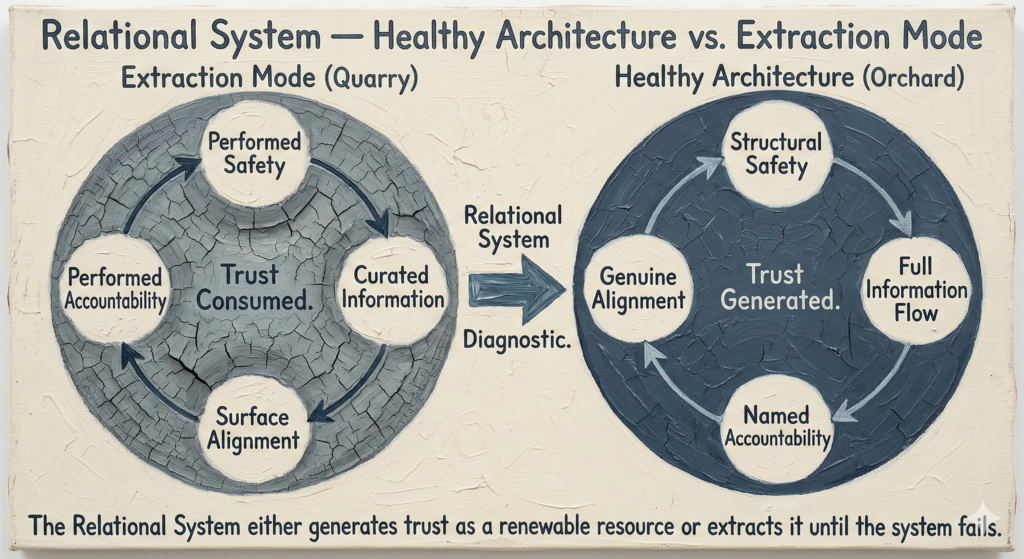
The Relational System, as ASQ applies it, is the architecture of trust, communication, and recognition within an organization. Like all systems, it operates at multiple scales simultaneously: in the individual leader’s relational patterns, in the team’s daily interactions, and in the organization’s formal and informal structures. The patterns operating at the organizational scale are almost always a reflection of the patterns operating in leadership, not metaphorically, but structurally. The leader who avoids direct conflict builds an organization that avoids direct conflict. The leader who curates what she tells the board builds a team that curates what it tells her. The leader who responds to bad news with visible distress builds a culture in which bad news is no longer delivered early.

This is the fractal principle: the same pattern, operating at different scales.

A psychological safety training program does not address this because it does not address the leader’s own relational patterns, the source of the organizational pattern. It treats the organizational symptom while leaving the individual source intact. The pattern reproduces.

In communities like those served by nonprofits across the Treasure Coast, where organizational density is high, where the same fifteen executive directors sit in the same rooms at the same funder convenings year after year, where staff turnover in one organization affects the talent pipeline across an entire sector, the cost of a broken Relational System is not contained within a single organization. It distributes. It accumulates. It becomes the background condition against which every mission-driven initiative in the region operates.

The Relational System assessment does not ask whether people feel good at work. It examines the specific structural conditions under which honesty, accountability, and genuine alignment are either possible or systematically prevented. The presence or absence of those conditions, not the team’s goodwill, not the leader’s effort, not the strength of the mission, determines what is possible organizationally.

That is a quarry, not an orchard. And it is repairable, not through training, but through architecture.

If you want to know where your organization’s Relational System is intact and where it is performing, the Leadership Capacity Assessment gives you that diagnostic in fifteen minutes.
Take it at Leadership Capacity Assessment

References

Edmondson, A. C. (1999). Psychological safety and learning behavior in work teams. Administrative Science Quarterly, 44(2), 350–383. https://doi.org/10.2307/2666999

Edmondson, A. C. (2018). The fearless organization: Creating psychological safety in the workplace for learning, innovation, and growth. Wiley.

Lencioni, P. (2002). The five dysfunctions of a team: A leadership fable. Jossey-Bass.

Meadows, D. H. (2008). Thinking in systems: A primer. Chelsea Green Publishing.

Senge, P. M. (1990). The fifth discipline: The art and practice of the learning organization. Doubleday/Currency.