

It was 8:47 PM on a Tuesday in coastal Florida when the text came through: “Keep your teams visible on the streets. Donors might drive by.”
Outside, lightning carved the sky. Rain hammered sidewalks already ankle-deep in water. The National Weather Service had issued flood warnings. Our frontline workers—the ones who’d been serving vulnerable populations for 8 straight hours—were being asked to remain exposed in a known flood zone. Not because it would help anyone. Not because the mission required it. But because an administration member was concerned about “the optics” if a major donor happened to pass by and didn’t see boots on the ground.
This wasn’t leadership. This was theater. Dangerous, mission-corrupting theater that happens when organizations mistake performance metrics for purpose, when grant compliance replaces human judgment, and when donor perception becomes more valuable than worker safety.
This is the quarry mindset at its most brutal: extracting visible output at any human cost, measuring what can be photographed rather than what actually transforms lives. And it’s metastasizing across the nonprofit sectors like a silent epidemic.
1. The Measurement Theater Industrial Complex
Modern nonprofit management has created a peculiar pathology: organizations now spend more energy demonstrating impact than generating it. The pressure comes from all sides:
Grant Requirements: Federal and foundation grants demand predetermined KPIs, often designed before community needs are fully understood. Miss your target by 5%? Risk losing next year’s funding, regardless of qualitative transformation.
Donor Expectations: Individual and corporate donors want Instagram-worthy proof of impact—smiling faces, clean metrics, visible activity. Nuanced, long-term systemic change doesn’t photograph well.
Accreditation Standards: Third-party evaluators measure what’s measurable: client contacts, service hours, program completion rates. They rarely measure what’s meaningful: dignity restored, autonomy rebuilt, communities strengthened.
Board Anxiety: Well-meaning board members, often drawn from the for-profit world, import shareholder capitalism’s playbook: “What gets measured gets managed.” Except humans aren’t widgets, and mission impact isn’t quarterly earnings.
The result? Organizations contort themselves into measurement-friendly shapes that may have nothing to do with their actual purpose.
2. Shareholder vs. Stakeholder: The Battle in Mission-Driven Work
The quarry versus orchard distinction isn’t limited to corporate America. It’s raging—often invisibly—inside mission-driven organizations:
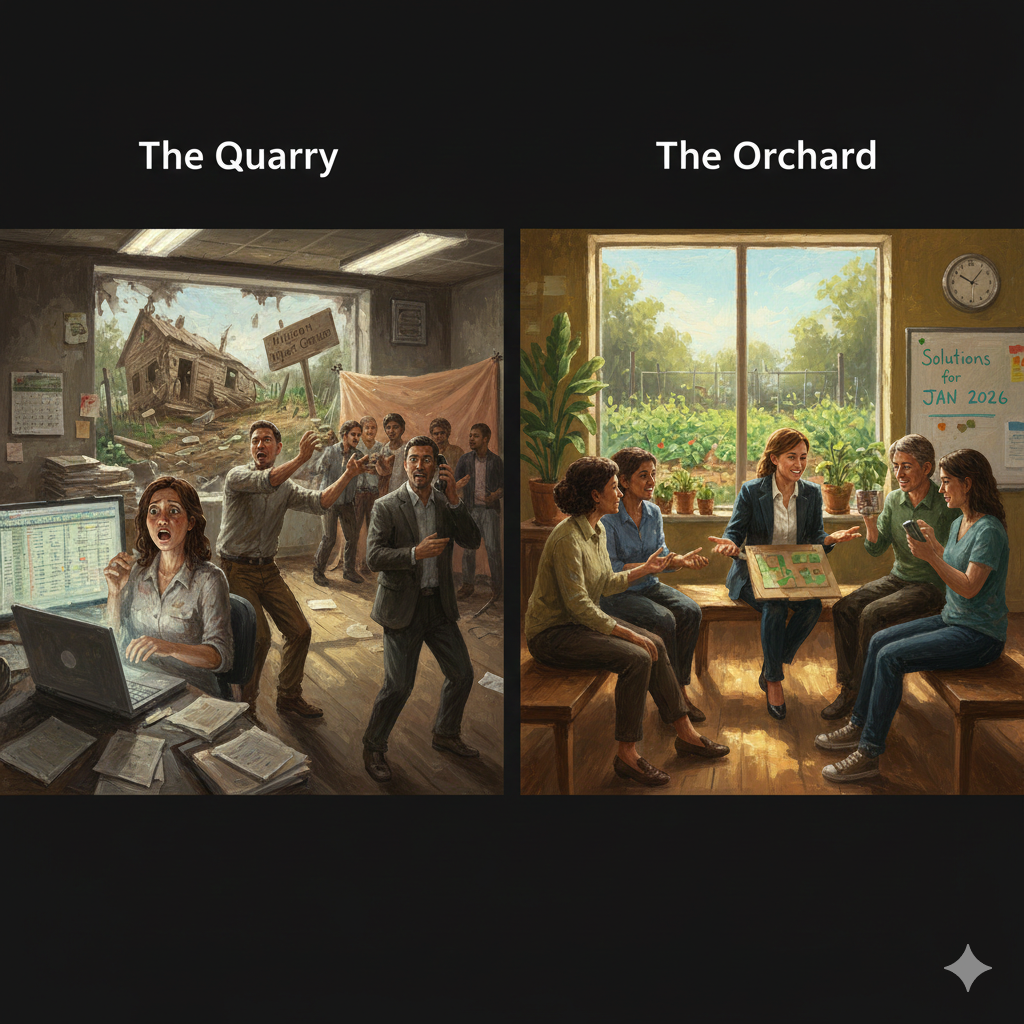
The Quarry Nonprofit:
- Optimize for: Grant renewal, donor satisfaction, board optics
- Measure: Service volume, cost per client, compliance documentation
- Decision Framework: “Will this look good in the annual report?”
- Worker Treatment: Expendable inputs toward measurable outputs
- Innovation Posture: Risk-averse (might miss KPI targets)
- Mission Creep: Follows funding streams, not community need
The Orchard Nonprofit:
- Optimize for: Long-term community transformation, worker sustainability
- Measure: Quality of relationships, systemic change indicators, worker well-being
- Decision Framework: “Does this serve our deepest purpose?”
- Worker Treatment: Essential stakeholders whose insight drives strategy
- Innovation Posture: Experimental (tests better ways to achieve mission)
- Mission Integrity: Shapes funding strategy around purpose, not vice versa
That night during the Florida storm, the choice was clear: operate from quarry extraction logic (maximize visible output, regardless of human cost) or orchard cultivation logic (protect the people who make mission possible, trust their judgement about when conditions are unsafe).The directive to keep workers exposed in dangerous weather wasn’t an outlier. It was a symptom of systemic dysfunction: when organizations serve their measurement systems rather than their missions, people become disposable.
3. The Innovation Stranglehold
Perhaps the most insidious cost of measurement theater is its impact on innovation. When organizations are bound to predetermined KPIs and donor expectations, they lose the freedom to experiment with more effective approaches.
Consider these common scenarios:
The Better Method You Can’t Use: A homeless services organization discovers that providing stable housing first (before requiring sobriety or employment) dramatically improves long-term outcomes. But their grants measure “program completion rates” based on sequential steps through treatment. Housing First would blow up their KPIs, even as it better serves their mission.
The Honest Conversation You Can’t Have: A youth development program realizes that 40% of their participants would be better served by a completely different approach—but admitting this to donors feels like failure. So they keep running a program that’s misaligned for nearly half their kids, because changing course might look like “mission drift.”
The Safety Protocol You Can’t Implement: Frontline workers identify that evening hours in a particular neighborhood have become dangerous. But grant deliverables require X number of evening contacts. Leadership faces an impossible choice: meet the measurement target or protect worker safety.

This is the quarry mindset at work: predetermined extraction targets override adaptive intelligence. The measurement system becomes more important than the mission it was designed to serve.
4. The Hidden Cost: Burning Out Your Best People
There’s a direct line between measurement theater and the nonprofit burnout epidemic (95% of nonprofit leaders report burnout concerns—a crisis we’ve examined extensively in our research on extractive leadership models).
When frontline workers are treated as measurement-production units rather than mission-critical stakeholders, several predictable patterns emerge:
Moral Injury: Workers entered nonprofit work because they care about the mission. When they’re asked to prioritize optics over impact, to risk safety for appearances, to game metrics instead of serve people—this creates profound cognitive dissonance. They’re being asked to betray the values that brought them to the work.
Expertise Dismissal: Frontline workers often have the clearest understanding of what’s working and what isn’t. They see the gap between measured outputs and actual outcomes. But in quarry organizations, their insights are rarely solicited. “Just hit your numbers” replaces “What are you learning?”
Sustainable Pace Impossible: When KPI targets are set without input from those doing the work, they’re often unrealistic. Workers exhaust themselves trying to meet arbitrary benchmarks, knowing that failure might cost the organization funding—and their colleagues, jobs.
Innovation Suppression: The workers closest to the mission are often the most creative problem-solvers. But in measurement-obsessed cultures, they learn quickly: novel approaches that might better serve mission but don’t fit measurement categories are career-limiting. Conformity is rewarded. Creativity is punished.
That Florida storm wasn’t about weather. It was about which stakeholders matter in organizational decision-making. And when worker safety comes second to donor perception, you’ve told your team exactly where they rank in your stakeholder calculus.
The organization lost three frontline workers within two months of that incident, including me. Not because of the storm. But, rather, what the storm revealed about whose well-being actually mattered
5. The Stakeholder Capitalism Alternative
Milton Hershey provides a better model—not just for corporate leadership, but for mission-driven work. During the Great Depression, when most organizations were contracting, Hershey went on a building spree. Why? To keep workers employed. To sustain the community. To maintain organizational capacity for when conditions improved.
This wasn’t charity. It was stakeholder capitalism: the recognition that organizational health depends on the flourishing of everyone connected to the mission—workers, clients, community, long-term donors who care about impact over optics.
Translated to modern nonprofits, stakeholder leadership means:
Worker Safety and Well-Being as Non-Negotiable
No KPI, grant deliverable, or donor perception justifies putting workers at risk. Full stop. Organizations that can’t operate this way need to renegotiate their grants, educate their donors, or change their models.
Frontline Wisdom Drives Strategy
The people closest to the work should have significant input into what gets measured and how. If there’s a gap between their lived experience and what the spreadsheet says, trust the humans, not the data.
Innovation Space Protected
Build into every program budget the capacity to experiment. Allocate 10-20% of effort toward testing better approaches, even if they don’t fit current measurement frameworks. Document learnings rigorously, then use this evidence to negotiate with funders.
Honest Stakeholder Communication
When measurement systems and mission come into conflict, have the courage to tell funders and donors the truth. Many will respect the integrity. Those who don’t weren’t aligned with your mission anyway.
Long-Term Capacity Over Short-Term Metrics
Invest in worker development, organizational learning, community relationship-building—even when these don’t produce immediate measurable outputs. These are orchard activities: cultivating soil and roots that will yield harvest for generations.
6. Practical Steps: From Quarry Extraction to Orchard Cultivation
For nonprofit and NGO leaders feeling trapped in the measurement theater cycle, here are concrete steps toward stakeholder-centered operations:
Short-Term (Next 90 Days):
1. Audit Your Decision-Making: Review the last ten significant decisions your leadership team made. For each, identify: Who was prioritized? Workers, clients, funders, board, community, long-term mission? Patterns will emerge.
2. Create Safety Protocols: Establish non-negotiable boundaries around worker safety and well-being. Document these. Share them with funders and board. If anyone objects, you’ve identified a stakeholder misalignment that needs immediate attention.
3. Install Feedback Loops: Create regular, structured opportunities for frontline workers to share what they’re learning—especially when it contradicts official metrics. Protect these conversations from being co-opted into positive spin for donors.
Medium-Term (Next 6-12 Months):
4. Renegotiate Measurement Frameworks: Approach your top three funders with this proposition: “We want to be accountable for real impact, not measurement theater. Can we collaborate on metrics that actually track mission fulfillment?” Many funders are hungry for this conversation.
5. Build Innovation Capacity: Designate specific time/budget for experimentation. Use Design Thinking methodology (see Framework 3 in our approach) to prototype new approaches with community input, test them in low-risk settings, and document learnings.
6. Educate Your Board: If board members are pushing for shareholder-style metrics, this is a teaching opportunity. Share the research on stakeholder capitalism’s superior returns. Help them understand that long-term mission impact requires different measurement approaches than quarterly earnings.
Long-Term (1-3 Years):
7. Diversify Funding Strategically: Reduce dependence on any single funder or funding stream that forces mission compromise. Build relationships with donors who care about long-term impact over short-term optics.
8. Document and Share Your Model: As you shift toward stakeholder-centered operations, rigorously document outcomes (including qualitative transformation indicators). Publish your findings. This creates cover for other organizations to follow suit.
9. Join or Create Learning Communities: Connect with other mission-driven leaders making this transition. Share challenges, strategies, and evidence. The sector shifts fastest when leaders support each other’s courage.
7. The Storm Will Come
That Florida storm wasn’t unique. Every mission-driven organization will face moments when measurement pressure conflicts with mission integrity, when donor optics compete with worker safety, or when short-term KPIs threaten long-term impact.
These moments reveal who we actually are—not who we claim to be in our mission statements.
Are we quarries extracting measurable output from expendable humans? Or are we orchards cultivating sustainable ecosystems where workers, clients, and communities can all flourish?
The choice isn’t between accountability and care. It’s between extractive measurement (designed to satisfy funders and board) and regenerative measurement (designed to improve mission impact and stakeholder well-being).
Organizations that choose the orchard path face real challenges. Some grants may be lost. Some donors may walk. Some board members may resist. This is painful.
But here’s what they gain: workers who bring their full creativity and commitment to the mission. Innovation that actually improves outcomes. Community trust built on integrity rather than performance. Long-term resilience instead of burnout churn. And the possibility of genuine transformation rather than photographable compliance.
The measurement theater industrial complex is powerful. But it’s not inevitable.
Every time a leader says “worker safety comes first, even if it affects our metrics,” they’re cultivating different soil. Every time an organization tells a funder “we need flexibility to innovate toward mission, not rigidity toward compliance,” they’re planting different seeds. Every time a board chooses long-term stakeholder flourishing over short-term optics, they’re watering a different kind of growth.
This is the shift from quarry to orchard. From extraction to cultivation. From shareholder pressure to stakeholder prosperity.
It’s the work of a generation. And it starts with leaders who have the courage to ask: What are we actually cultivating here?
References
Brown, B. (2018). Dare to Lead: Brave Work. Tough Conversations. Whole Hearts. Random House.
Gelles, D. (2022). The man who broke capitalism: How Jack Welch gutted the heartland and crushed the soul of corporate America—and how to undo his legacy. Simon & Schuster.
Gallup. (2023). State of the Global Workplace Report.
Kotter, J. P., & Heskett, J. L. (1992). Corporate Culture and Performance. Free Press.
Society for Human Resource Management (SHRM). (2022). The Real Costs of Recruitment.
Watson Wyatt. (2002). WorkUSA Study: The Relationship Between Trust and Financial Performance.Zak, P. J. (2017). The Neuroscience of Trust. Harvard Business Review, 95(1), 84-90.