

The modern workplace is in a state of crisis. A staggering 95% of nonprofit leaders report deep concern about staff burnout, while globally, a mere 23% of employees feel engaged in their work. These are not isolated skill gaps or temporary operational challenges; they are symptoms of a profound “coherence gap” at the heart of modern leadership—a chasm between how we manage people and how human beings are designed to thrive.
For the last four decades, a single, fundamentally broken philosophy has dominated corporate culture. It treats people as resources to be mined, productivity as a commodity to be extracted, and shareholder returns as the sole measure of success. This is the leadership model of the Quarry. It excels at producing short-term gains but inevitably leaves behind a barren wasteland of depleted talent, broken trust, and unsustainable organizations.
This white paper dissects the failures of that extractive model and presents a coherent, human-centered alternative: the leadership model of the Orchard. The Orchard is a cultivation model, focused on creating the conditions for long-term flourishing. It understands that by stewarding its ecosystem—its employees, customers, and communities—it can produce not just a single harvest, but generational abundance. We will examine the anatomy of the extractive model, trace its devastating human costs, and provide a practical blueprint for leaders who wish to cultivate durable value and leave a legacy of growth, not depletion. Our analysis begins by excavating the foundations of the Quarry.
1. The Barren Quarry: Anatomy of the Extractive Model
To understand the crisis facing modern organizations, we must first understand the dominant leadership philosophy of the past 40 years: shareholder primacy. This model, which posits that a corporation’s sole responsibility is to maximize profits for its shareholders, was not an inevitable law of economics but a deliberate strategic choice. Its chief architect was Jack Welch, the iconic CEO of General Electric from 1981 to 2001, whose management style became the unquestioned playbook for a generation of executives. Welchism succeeded by creating a dangerously coherent, if toxic, system. It leveraged the Recognition engine (status, stock price) for a select few while weaponizing the Survival engine (fear of being cut) for the many, creating a culture of hyper-individualistic performance that was ultimately self-cannibalizing. The core tenets of this doctrine promised to unlock unprecedented value but relied on a set of internal tactics that systematically eroded the foundations of the organization itself.
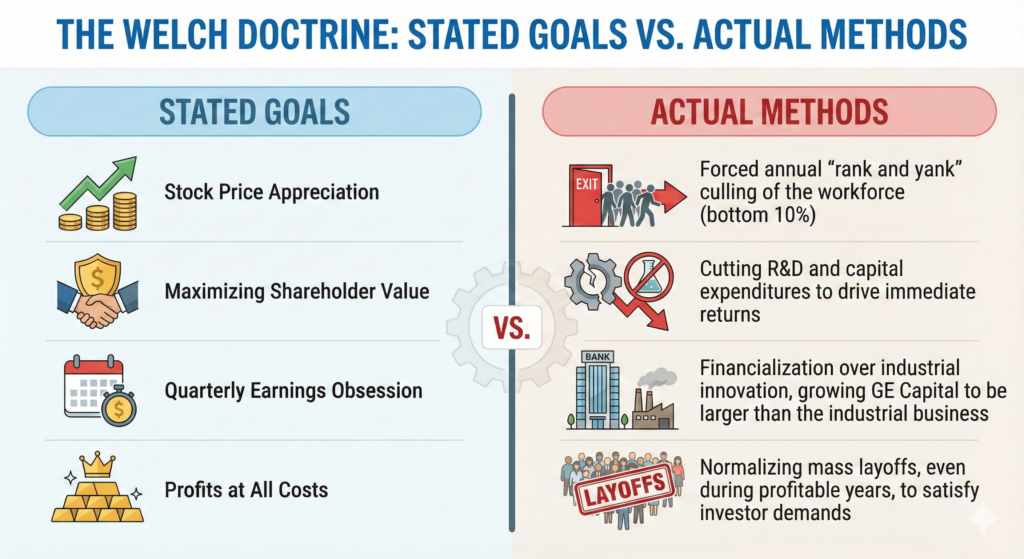
The short-term results were intoxicating. During Welch’s tenure, GE’s stock price soared by an astonishing 4,000%, and he was named “Manager of the Century.” Yet this meteoric rise was a mirage built on a hollowed-out foundation. The long-term consequences were catastrophic. By 2018, GE had lost $600 billion in market value and was ignominiously removed from the Dow Jones Industrial Average, the very index it had helped create. Welch’s successor inherited a company whose core businesses had been starved of capital and innovation for decades.
More profoundly, this model shattered the long-standing social contract between employer and employee. Mass layoffs were no longer a measure of last resort but a routine tool for satisfying Wall Street. This created a culture of fear that destroyed institutional knowledge, psychological safety, and the long-term organizational coherence necessary for sustainable success. This systemic dismantling of organizational coherence did not just create an unstable economic entity; it created a clinical environment ideal for generating widespread psychological and physiological injury.
2. The Human Cost: How the Quarry Breeds Burnout and Trauma
For leaders, understanding the psychological and physiological consequences of extractive work environments is not a “soft skill”—it is a strategic imperative. The Quarry model, with its relentless pressure, lack of safety, and disregard for human needs, creates the ideal conditions for two of the most destructive forces in organizational life: burnout and trauma.
Burnout is more than just exhaustion; it is a clinical state defined by three core components:
- Emotional Exhaustion: The feeling of being completely drained after caring too much for too long.
- Depersonalization: A dwindling capacity for compassion and empathy.
- Decreased Sense of Accomplishment: The pervasive feeling that “nothing I do matters.”
Burnout occurs when we get stuck in an emotional tunnel without an exit. This is directly related to a biological process known as the stress cycle. The human body’s stress response—a flood of hormones that elevate heart rate and tense muscles—is designed for acute, physical threats, like running from a charging rhino. The cycle is meant to close when we reach safety. In the modern workplace, stressors are chronic and abstract, and we rarely get the signal that the threat is over. When the stress cycle is never closed, the body remains in a state of high alert, leading to chronic high blood pressure, compromised immunity, and a host of cardiovascular diseases.
Scientifically-backed methods for closing the stress cycle include:
- 20-60 minutes of physical exercise
- Creative expression (art, music, theater)
- Positive social interaction (laughter, a genuine hug)
While burnout is a state of being stuck, trauma is the lasting damage that results from overwhelming experiences. As Dr. Bessel van der Kolk defines it, trauma is not the past event itself, but “the imprint left by that experience on mind, brain, and body.” Crucially, he finds that “immobilization is at the root of most traumas.” The inability to take effective action in the face of a threat is what makes an event traumatic.
From a strategic perspective, an organization that creates the conditions for trauma is an organization that systematically destroys its own human capital, creating long-term liabilities in health costs, turnover, and lost innovation that far exceed any short-term gains from coercive tactics. The constant threat of “rank and yank,” the powerlessness to influence decisions, and the demand to suppress one’s own needs create a state of learned helplessness. This unresolved trauma manifests physically as chronic pain and autoimmune diseases, and relationally as a profound inability to trust others or feel safe in connection.
If this is the devastating human and organizational cost of operating a Quarry, what does the alternative look like? And more importantly, is it economically viable?
3. The Flourishing Orchard: A Blueprint for Cultivation
The alternative to the extractive Quarry is the cultivated Orchard. This model, often called stakeholder capitalism, is not a charitable endeavor but a fundamentally superior strategy for creating durable, long-term value. It operates on the principle that shareholder value is an outcome of a healthy organization, not its sole purpose.
The archetypal cultivator is Milton Hershey. In stark contrast to Welch, Hershey built his empire on the premise that a business exists to serve all its stakeholders—employees, community, and customers—and that profit naturally follows purpose. The Hershey model was a self-sustaining ecosystem built on three core components:
- Community as the Foundation: Hershey didn’t just build a factory; he built a town. Hershey, Pennsylvania, was created as a “Shangri-La” for his workers, complete with high-quality schools, affordable housing, parks, and transportation. He understood that a thriving workforce required a thriving community.
- Governance for Legacy: To ensure his mission outlived him, Hershey placed the controlling interest of his company into the Hershey Trust. Today, the Trust still holds 80% of the voting shares, ensuring that a significant portion of the company’s profits perpetually fund educational and community initiatives, protecting the organization from short-term, extractive pressures.
- Engagement as an Engine: Hershey recognized that worker well-being was the primary driver of innovation and quality. A secure and engaged workforce led to iconic product developments and gave the company profound economic resilience, allowing it to not only survive but expand and hire through the Great Depression.
Decades later, a wealth of economic data has validated the superiority of Hershey’s cultivation model.
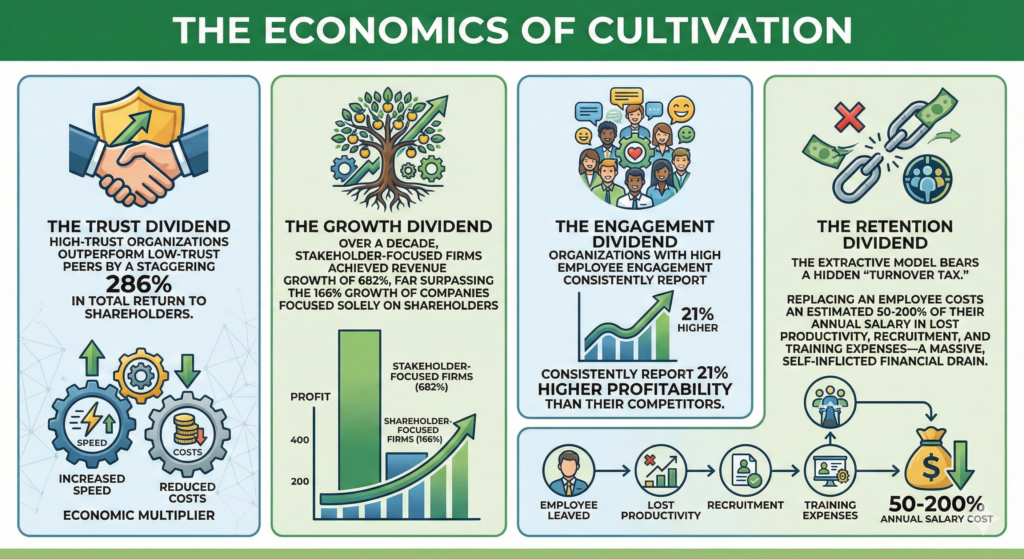
The Economics of Cultivation
- The Trust Dividend: High-trust organizations outperform their low-trust peers by a staggering 286% in total return to shareholders. Trust acts as an economic multiplier, increasing speed and reducing costs.
- The Growth Dividend: Over a decade, stakeholder-focused firms achieved revenue growth of 682%, far surpassing the 166% growth of companies focused solely on shareholders.
- The Engagement Dividend: Organizations with high employee engagement consistently report 21% higher profitability than their competitors.
- The Retention Dividend: The extractive model bears a hidden “turnover tax.” Replacing an employee costs an estimated 50-200% of their annual salary in lost productivity, recruitment, and training expenses—a massive, self-inflicted financial drain.
The central analogy holds: Welchism is like mining a forest. You can generate immense immediate wealth by clear-cutting everything in sight, but you will eventually be left with a barren, worthless wasteland. Hersheyism is like cultivating an orchard. You invest in the health of the soil and the trees—the stakeholders—which is the only way to ensure a bountiful and profitable harvest for generations. To build an orchard, however, requires more than just different tools; it requires a new internal operating system for the leader.
4. Cultivating Coherence: A New Leadership Operating System
Shifting from a Quarry to an Orchard is not a matter of changing tactics; it demands a fundamental upgrade to a leader’s internal “operating system.” Leaders must move beyond managing for extraction and learn to lead for human flourishing. This requires a new map for diagnosing what is broken and a new process for rebuilding organizational health.
The map is The Drive System™, a framework that identifies the eight fundamental human needs, or “engines,” hardwired into our biology. Effective leaders must learn to honor and integrate all of them: Survival, Connection, Power, Recognition, Pleasure, Creation, Truth, and Transcendence.
The core insight is that all eight engines are sacred and necessary. The Quarry model systematically suppresses foundational engines like Survival (safety), Connection (belonging), and Pleasure (joy). Welch’s “rank and yank” methodology is a direct assault on the Survival engine, creating chronic threat, and the Connection engine, severing bonds of trust. His obsession with quarterly earnings overstimulates a narrow band of the Creation engine (productivity) at the expense of all others. This internal fragmentation, when projected onto an organization, manufactures the “Burnt-Out Achiever” archetype at an industrial scale: a leader with an overdeveloped Creative System but collapsed Vital and Relational Systems.
If The Drive System™ is the diagnostic map of what needs to be cultivated, then Design Thinking is the human-centered process for building the Orchard. Where Welchism relies on top-down directives based on abstract financial targets, Design Thinking begins with Empathize—a process Welch deemed inefficient. Where Welchism implemented monolithic, fear-based policies, Design Thinking uses iterative Prototyping and Testing, building solutions with people, not imposing them on people. Its five-stage methodology offers a practical path for developing solutions that meet real human needs:
- Empathize: Deeply understand the experiences of your people.
- Define: Clearly articulate the core problems from their perspective.
- Ideate: Brainstorm a wide range of potential solutions.
- Prototype: Build quick, tangible versions of ideas to test.
- Test: Gather real feedback from users to learn and iterate.
The core principles of Design Thinking—Human-Centered, Iterative, and Collaborative—serve as a direct operational antidote to the top-down, numbers-obsessed, and fear-based methodology of Welchism. This combination—a map of human needs and a process for meeting them—provides the operating system for the modern leader, framing the ultimate choice every leader must make.
5. Conclusion: Choosing Your Legacy
Every leader stands at a crossroads, facing a fundamental choice: to be an extractor who manages a Quarry or a cultivator who stewards an Orchard. The extractive model, with its promise of rapid gains, is a seductive but ultimately hollow path. It leaves behind depleted organizations, burnt-out people, and a legacy of generational loss. The cultivation model requires patience, courage, and a deeper definition of success, but it builds institutions that are resilient, innovative, and generative.
The final, critical argument of this analysis is this: Shareholder value is an outcome of stakeholder coherence, not the driver of it. Jack Welch had the causality backward. By prioritizing a single metric, he destroyed the very ecosystem—the trust, engagement, and innovation—that creates durable value in the first place.
The challenge for today’s leaders is to move beyond this broken and outdated model. It is time to adopt a practice of leadership that understands wealth creation and human flourishing are not opposing forces, but are, in fact, two parts of a single, coherent system. The ultimate measure of leadership is not the value extracted in a single quarter, but the abundance created for generations to come. The choice is yours: will you mine a forest, or will you cultivate an orchard?
References
Gallup. (2023). State of the global workplace 2023 report: The voice of the world’s employees. Gallup, Inc. https://www.gallup.com/workplace
Gelles, D. (2022). The man who broke capitalism: How Jack Welch gutted the heartland and crushed the soul of corporate America—and how to undo his legacy. Simon & Schuster. https://www.simonandschuster.com
Hershey Trust Company. (n.d.). Our mission and governance. https://www.hersheytrust.org
IDEO. (2015). The field guide to human-centered design (2nd ed.). IDEO.org. https://www.designkit.org
Watson Wyatt Worldwide. (2002). WorkUSA® 2002: Weathering the storm—A study of employee commitment and its impact on performance. Watson Wyatt.
Willis Towers Watson. (2019). The link between culture and financial performance. https://www.willistowerswatson.com
World Health Organization. (2019). Burn-out an “occupational phenomenon”: International Classification of Diseases. https://www.who.int
Collins, J. (2001). Good to great: Why some companies make the leap… and others don’t. HarperBusiness.
Groysberg, B., & Slind, M. (2012). Leadership is a conversation. Harvard Business Review, 90(6), 76–84.
Kelley, T., & Kelley, D. (2013). Creative confidence: Unleashing the creative potential within us all. Crown Business.
Kotter, J. P., & Heskett, J. L. (1992). Corporate culture and performance. Free Press.
Society for Human Resource Management. (2022). The real costs of recruitment. SHRM Research Reports.
van der Kolk, B. (2014). The body keeps the score: Brain, mind, and body in the healing of trauma. Viking.Watson Wyatt Worldwide. (2002). WorkUSA 2002: Weathering the storm—A study of employee attitudes and opinions. Watson Wyatt Worldwide.