

In mission-driven organizations, the most dangerous cultural pattern looks like cooperation.
The meeting went well.
No one raised a concern. No one questioned the timeline. The agenda moved cleanly from item to item, and the executive director left the conference room with a completed action list and the general impression that her team was aligned.
What she did not have was honesty.
Three weeks later, two of her senior program staff submitted resignations in the same week. Neither letter named a specific incident. Both used the phrase “pursuing new opportunities.” She never learned what they had needed her to hear in that room.
This is what a broken Relational System looks like from a leadership position. Organized. Professional. Cooperative. And quietly extracting its most committed people.
The Pressure That Produces Silence
Mission-driven organizations — the nonprofits serving families in Fort Pierce, the community health programs operating across Martin County, the youth development organizations holding St. Lucie County together with inadequate budgets and overextended staff — run on something that most sectors can only approximate: genuine personal commitment to the work.
That commitment is the organization’s primary asset. It is also the structural condition that makes trust breakdown nearly invisible until it is too late.
When a team member cares deeply about the mission, naming a problem carries a cost that is specific to this sector. Disagreement can feel like disloyalty. Expressing difficulty can feel like a complaint. Raising a hard question in a staff meeting can feel, in the specific culture of mission-driven organizations, like abandoning the cause; as though the problem-namer has somehow placed personal discomfort above collective purpose.
So people learn not to name things.
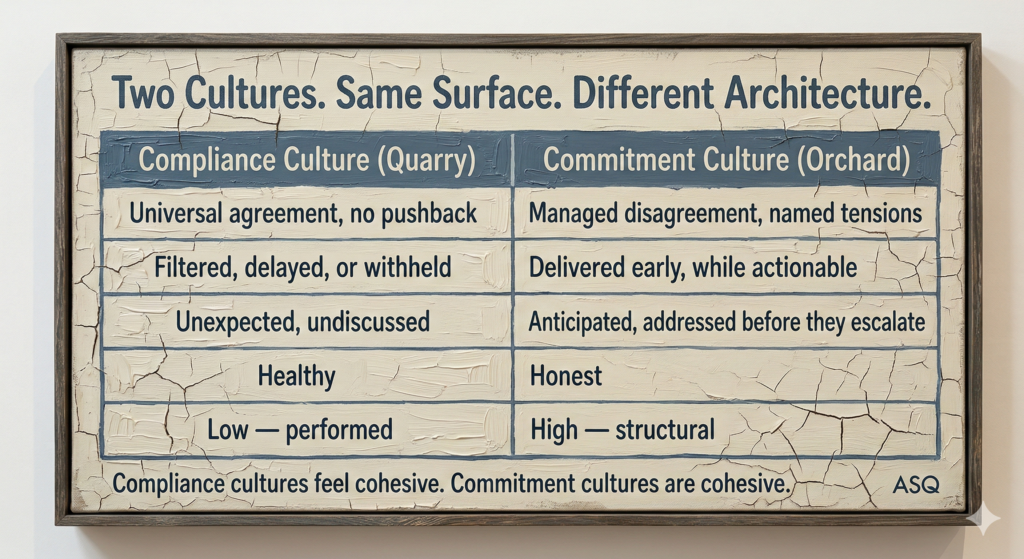
Amy Edmondson’s research on psychological safety, developed across two decades of organizational study at Harvard Business School, identifies a pattern that runs counter to how most leaders read their teams. Low-trust organizations do not feel hostile. They feel cooperative. Their defining characteristic is not conflict; it is the systematic absence of honest, early communication: the kind of communication that arrives while there is still time to act on it (Edmondson, 1999). The team that never brings bad news early is not a team that has nothing bad to report. It is a team that has assessed the risk of reporting and concluded that silence is safer.
In mission-driven organizations on the Treasure Coast, this assessment happens quietly, repeatedly, invisibly, until someone leaves, and the leader discovers, too late, that the real conversation was happening somewhere other than the room she was in.
Four Patterns That Appear Before the Problem Is Named
Trust does not collapse in a single event. It erodes through small, repeated moments, most of which a leader never directly observes. These four relational patterns function as structural indicators. They are measurable. They are consistent. And they appear well before the departure letter, the grant rejection, or the board conversation that finally surfaces the real organizational condition.
Information hoarding. When team members begin curating what reaches leadership, not lying, but selectively reporting, they are communicating something structural: full transparency feels unsafe. This pattern presents, from the leader’s perspective, as exceptional operations. Polished updates. No surprises. Reports that arrive complete and on time. A leader who never hears difficult news early is not managing a high-performing team. She is managing a team that has decided it is not worth telling her things while they are still manageable.
Performative agreement. The formal meeting produces consensus. The informal meeting, in the parking lot, in the group text, in the quiet thirty-second exchange before the workday ends, produces a different view. When these two conversations run in parallel for long enough, the organization is no longer making real decisions in formal spaces. It is ratifying decisions that have already been made without her, using the meeting as a documentation exercise. This is not a communication problem. It is a structural symptom of a Relational System operating in extraction mode.
Selective silence. There are topics that do not get named in certain organizations. The pattern of behavior from a specific senior leader that everyone has worked around for two years. The gap between what the strategic plan says and how decisions are actually made. The resource constraint that is quietly shaping every program decision but has never been named in a board meeting. Selective silence is not an absence of information. It is the active management of information, people mining their own discretion to preserve their position in a system they have determined will penalize honesty.
Blame diffusion. When something goes wrong inside a low-trust structure, accountability does not consolidate. It disperses into a collection of contributing factors with no clear owner. The postmortem produces a list. Nobody is wrong. Nobody is responsible. This is not evidence of a team without integrity. It is evidence of a team without the structural safety required to say: this was mine to prevent, and I did not prevent it. That level of professional exposure requires trust that the organization never built.

The Relational System Is Not a Culture Problem
Here is where the standard organizational response fails.
When these patterns surface, through a resignation, a Glassdoor review, a board conversation about staff morale, the typical response is programmatic: a psychological safety workshop, a new feedback framework, a half-day retreat built around “courageous conversations.” These interventions are not useless. But they address the behavior, not the structure that produced it. Three months later, the framework is a memory, and the patterns are unchanged, because the source of the pattern was never examined.
The Relational System, as ASQ applies it, is the architecture of trust, communication, and recognition within an organization. Like all systems, it operates at multiple scales simultaneously: in the individual leader’s relational patterns, in the team’s daily interactions, and in the organization’s formal and informal structures. The patterns operating at the organizational scale are almost always a reflection of the patterns operating in leadership, not metaphorically, but structurally. The leader who avoids direct conflict builds an organization that avoids direct conflict. The leader who curates what she tells the board builds a team that curates what it tells her. The leader who responds to bad news with visible distress builds a culture in which bad news is no longer delivered early.
This is the fractal principle: the same pattern, operating at different scales.
A psychological safety training program does not address this because it does not address the leader’s own relational patterns, the source of the organizational pattern. It treats the organizational symptom while leaving the individual source intact. The pattern reproduces.
In communities like those served by nonprofits across the Treasure Coast, where organizational density is high, where the same fifteen executive directors sit in the same rooms at the same funder convenings year after year, where staff turnover in one organization affects the talent pipeline across an entire sector, the cost of a broken Relational System is not contained within a single organization. It distributes. It accumulates. It becomes the background condition against which every mission-driven initiative in the region operates.
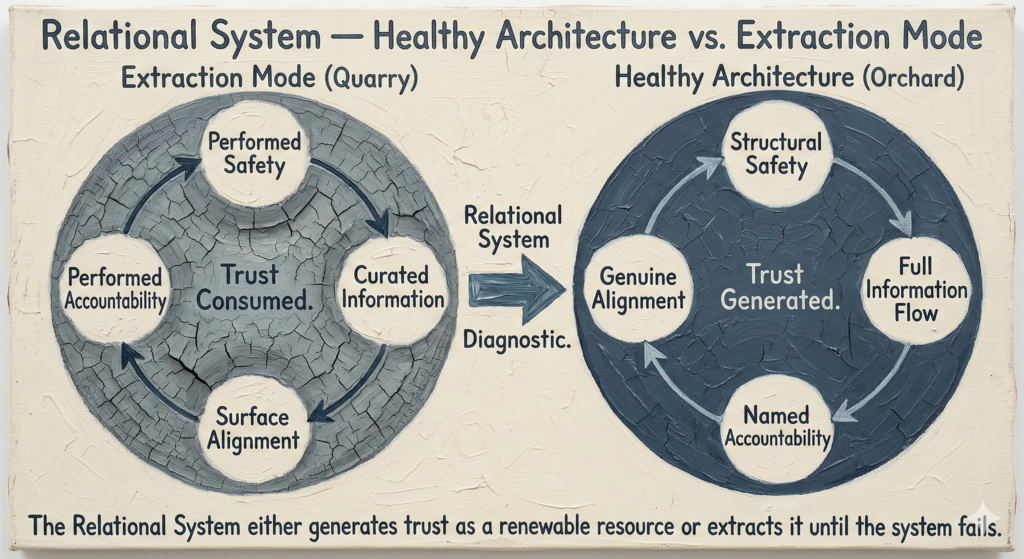
The Relational System assessment does not ask whether people feel good at work. It examines the specific structural conditions under which honesty, accountability, and genuine alignment are either possible or systematically prevented. The presence or absence of those conditions, not the team’s goodwill, not the leader’s effort, not the strength of the mission, determines what is possible organizationally.
That is a quarry, not an orchard. And it is repairable, not through training, but through architecture.
If you want to know where your organization’s Relational System is intact and where it is performing, the Leadership Capacity Assessment gives you that diagnostic in fifteen minutes.
Take it at Leadership Capacity Assessment
References
Edmondson, A. C. (1999). Psychological safety and learning behavior in work teams. Administrative Science Quarterly, 44(2), 350–383. https://doi.org/10.2307/2666999
Edmondson, A. C. (2018). The fearless organization: Creating psychological safety in the workplace for learning, innovation, and growth. Wiley.
Lencioni, P. (2002). The five dysfunctions of a team: A leadership fable. Jossey-Bass.
Meadows, D. H. (2008). Thinking in systems: A primer. Chelsea Green Publishing.
Senge, P. M. (1990). The fifth discipline: The art and practice of the learning organization. Doubleday/Currency.